Afghan Women’s Project
« Older EntriesGuest Post From Aysha, a student in a Kabuli high school
Sunday, January 12th, 2014
Aysha contacted me asking if I would edit her story about how she helped her classmates with some of psychological issues.
Aysha is an example of the younger generation in Afghanistan who are eager to improve themselves and rebuild their country. Aysha’s story is interesting because she shares her thought process as her seven-day project unfolds. Please leave comments for her below.
And now, I introduce Aysha…
Salaam Alikom means peace be with you.
We Muslims say this so that the person we are talking should know that he/she is safe with us and we mean no harm for them..
My name is Aysha Mirbacha and I study in Al-Fatha High School class 11. I live in Kabul, the capital of Afghanistan. My first day in Al-Fatha high school was in the year 2008. I didn’t have any friends, but at that time I did not lose myself mentally. I would just go to study and come back home. As time passed I found many friends, and they would talk with me and meet me, but one day I recognized that they never said that I was happy. In fact, they said it seems like I feel pain and am unhappy.
I thought: please kill me, my life means nothing. I started thinking why, that’s not normal. They helped by talking and sharing feelings. I start to think positively, but I knew that was not going to help. They should start thinking positively too.
MY SEVEN DAYS
Ever since I was younger, I learned and heard one thing: Be like a girl, don’t go out, don’t talk to strangers, you don’t need friends.
But then I said to myself “there is a better world, and if I know that then others should also”. I was thinking of what to do, how to help, and then I learned about depression on online websites and gathered answers to all my questions. In school, I talked to my teachers and one of my classmates. I started researching, and I wanted to show them that what are they doing and thinking is making their problems worse.
I had 7 days only because our exams were in 25 days.
Day 1_
I was thinking that I can’t do this alone. I need help.
One of my classmates, Shayesta, came and asked me, “Aysha what is the problem? Can I help you with it?” I invited her to join me, and she said “yes I would love to”. She made me very happy. Shayesta said, “keep on with your research and I will see what I can do.”
Day2_
I said to Shayesta: “This is too much pressure on me in 7 days. I can’t do this.”
She said to me: “Aysha, stress doesn’t solve anything.” I had my computer and Shayesta told me we can do this. I will find answers for the stress problems from the side of Islam because we all are Monotheists and we believe in one God. I will search using that strength and you should search from science to see what science can prove.
I told Shayeata that she solved all my problems once we both were alone.
No one was there to help us but we didn’t lose hope. We worked together and talked to our teachers and classmates – people I knew or even those I didn’t.
I was worried and I said to Shayesta: “what if the principal doesn’t accept our project?”
She said, “Aysha we aren’t doing anything bad, we are helping. They won’t say ‘no’ to us. They will give us a chance, don’t worry at all.”
Day3_
We were working on our research and thinking how to sort it better. I was in my computer lab since bringing computers to school is not allowed by my teacher.
She asked me: “what’s in your hand Aysha?” I said it was a computer and that we are working on a project about Afghan girls’ stress. I suddenly said that students have family and environment problems which prevent them from studying.
The teacher said that it sounded like a very good project. The teacher asked how she can help, and we were a little shocked!
She then said that we should give a conference about it and she would find a projector for us to use.
Sayesta and I were amazed.
Day4_
We had 3 days only. Time was passing so fast, and I found out how precious time is. We were working and praying that Allah may help us. But we faced a huge problem to meet the deadline.
Shayesta told me she wished we hadn’t done this at all and she didn’t think we can do it. I said yes we can. If you and I started this, we will finish it. I wasn’t sure about it and tears came out. I wiped them fast so she would not understand my doubts.
We decided to make question sheets so by writing we can see our problems. We decided that this Friday we would stay home and make our questions and then print them. Shayesta said to forget about it, we are not even ready for our conference. I told her to leave this responsibility to me.
Day5_
I was at home with my family helping my mom and sisters and brother with daily work, and during the evening I had time to work on my question sheets. I completed my writing and I practiced for my conference. Everything was going well until morning sunrise when I went to school. I was so tired. When I met with Shayesta she told me she wasn’t coming tomorrow since she had to work at home. I couldn’t do or say anything because it’s her family, and she may have personal problems.
I told her to be here on Monday for sure, but today we will practice. We went to the principal’s office we told her everything about our project. She was very happy. The principal also gave me a movie. She told me I should watch this and that I will find many answer since the movie was about the secret of happiness.
Then, we used our school printer for copies of the question sheets, but we weren’t allowed to print all we needed. We asked permission for the conference in school and it was granted so we were very happy. I felt like I was flying. We both were running and went to class when one of our teachers called and said she wanted to help us with this work. She led us to our school library to make 100 copies of the sheets, and believe it or not, I have been studying for four years and it was my first time in the school library.
She copied the question sheets for us, and Shayesta told me that our problems are getting solved.
Day-6
Tomorrow was the big day for me and Shayesta, and we were definitely ready.
Everyone wished us the best of luck including my teachers and classmates. We took the hall key and went to assemble the chairs, fans and I checked the mic. It was working well but the projector was not working. We tried our best but it still didn’t work. Some of my classmates came and we checked all the wires, but they were all broken. I asked for help to re-join them and then the projector worked. It was unbelievable!
When everything was ready for tomorrow, Shayesta told me best of luck tomorrow is our day.
I just smiled and walk away to class.
Day-7
Finally, it was the day we had been waiting for.
We both went to the principal’s office for the key, but the principal suddenly said that we were not allowed to go in the hall and give our conference! We were both shocked I asked why she didn’t tell us before.
We had worked hard on this project. This is not fair! Shayesta and I both were about to cry. We thought everything was done. When I turned my head, I saw my teachers and I ran to them but when they talked to the principal she didn’t change her mind. Shayesta said we are wasting time.
Walking in the stairs, I saw my teacher that had helped in the library and I rushed to her and told her everything. She went to the office and gave us the key. All my classmates came to help me and Shaesta went to call the students from other classes. Some went to ask teachers to come. So the conference got started.
At the start the announcer started her talk about our title and why are we giving this conference. Students and teachers liked the title and they said it was helpful. After the announcer and Shayesta finished, I started my speech. I was a little shy and scared because it was in front of hundreds of students and teachers. I start to wipe my sweat.
But at the end, everyone stood up and clapped for us. The feeling was perfect. After that many students came and asked me for help. When I finished Shayesta and I were surrounded by many students. I didn’t understand what they were doing and Sonam, the announcer, said they want help from me. My classmates came and asked questions one by one.
They said they felt like they were born again with a new life, happiness, love and everything beautiful in this world.
After 3 days, we were still working to help students who wanted to talk to the principal. The office called us to say we would be rewarded with a certificate. Shaysta, Sonam and I were very happy. I was proud to be me. I felt good and peaceful to help others girls around my school environment and I am looking forward to helping them more
Posted in Afghanistan, Aisha, education, Other, women, writers | 1 Comment »
Meeting Malalai
Tuesday, December 4th, 2012
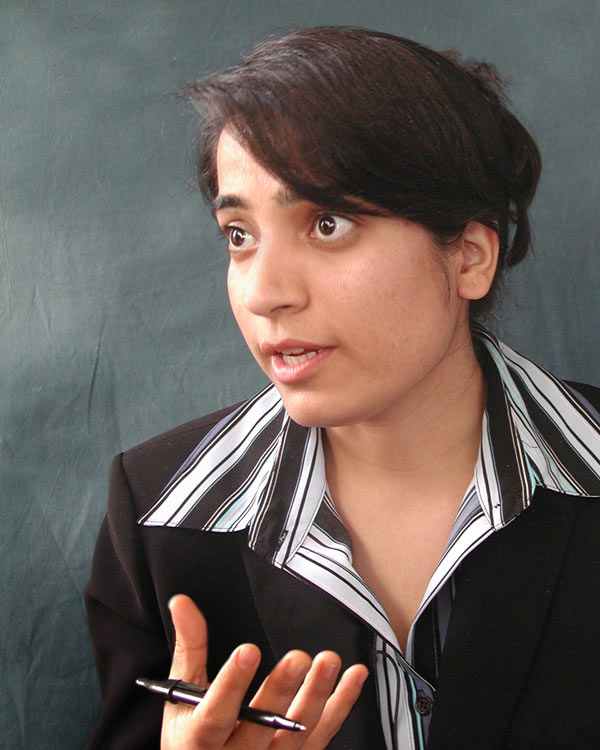 When I heard that Malalai was touring the US, I flew to Sonali Kolhatkar’s (author of Bleeding Afghanistan) California home where the young Afghan would be staying, to meet her. When Malalai walked into living room she seemed quiet and shy but once we began the interview, she became animated and energetic.
Malalai is most famous for her short speech as an elected member of the constitutional Loya Jerga (2003), when she addressed the elephant in the room that Afghans were already cognizant of and asked, how Afghanistan could become a democracy when there were warlords and criminals in the government. The audience erupted into angry chaos and her three-minute allotted speaking time was cut short after only a minute and a half. Angry lawmakers threw empty water bottles at her and shouted insults and death threats. Supporters and UN security forces gathered around to shield her. She was only 24 at the time. I met her during her first tour of the United States in 2006, after she had been elected as one of 249 Members of Parliament. Her outspokenness got her in trouble there as well and a year and two months later she was banned from that institution also.
At first, I wondered why she didn’t bite her tongue and try to work peacefully to make changes in the laws affecting women. Surely, that would be a more effective way to change women’s lives. Why stir the hornet’s nest? But then I realized that she wasn’t speaking to the other MPs, who already knew the situation, but to the international press and development leaders who were ready to pour billions in to Afghanistan’s reconstruction. They, too, were likely aware of the horrific human rights records of some of the MPs, but Malalai’s speaking out made that awareness public.
Malalai is also important because she’s a voice from a region across the country from Kabul. Most non-embedded reporters work from Kabul and investigate stories from there. Their view, the dominant one in the media, comes from that perspective and it’s very helpful to hear the voice of someone from conflict areas, especially a woman’s voice.
There is more of my interview with Malalai as well as with other Parliamentarians and women from all walks of life in my book, Gathering Strength: Conversations with Afghan Women which is available in many online bookstores as well as my publisher’s site, Pomegranate Grove Press.
****
Peggy Kelsey created the Afghan Women’s Project and in 2003 and 2010 traveled to Afghanistan to photograph and interview women. She shares her dynamic slide presentations with audiences around the world. Her book, Gathering Strength: Conversations with Afghan Women, came out in October, 2012.
Posted in Afghan Women's Project, Afghanistan, AWP 2010, Links, Other, Peggy Kelsey, Uncategorized, women | Comments Off on Meeting Malalai
Writing: Gathering Strength: Conversations with Afghan Women
Sunday, September 30th, 2012
Gathering Strength, my book of conversations with Afghan women, is published! I will have books in my hands by October 8th and on Amazon sometime around early November. (email me if you want me to send you a copy before November.) The writing process has taken nearly two and a half years but really, Gathering Strength is the culmination of ten years with The Afghan Women’s Project including two trips to Afghanistan.
It’s been over a year since my last post. I couldn’t tear myself away from writing and editing to write about the book. Now it’s the end of an era of narrow focus with a workaholic intensity.
When I started working on Gathering Strength I never imagined that I was capable of creating a work this profound and this beautiful. Of course it wasn’t all, or maybe even mostly my doing. Editing, layout and cover design have shaped this book into a form worthy of the Afghan women who shared their thoughts and stories with me.
From my last day in Afghanistan in May 2012, when I realized that I needed to and could write a book, I only knew that that I’d need an editor and that I would self-publish so I could maintain control over the material and the timing of publication. As I worked, I found that this book had a life and timing of its own and all I could do was to work as hard as I could (in a way balanced for the long haul) and be open to what came my way. Realizing that probably kept me from going crazy while trying to select from the myriad publishing and other options and it helped me be patient with my unrealistic imagined timeframe.
Thankfully, during the writing and editing, when I awoke in the mornings, I was driven out of bed to begin the day’s writing, a much different experience from the resistance I’d felt during past writing efforts. By the end I couldn’t wait for the writing/editing to be completed, but I never felt it to be drudgery.
As I wrote my early drafts, I dreamed of handing over the manuscript to someone who would transform it into a finished book for me; a knight in shining armor. Oh, well, that didn’t happen. Instead, I worked closely with my editors, going back and forth over different points, sometimes changing my mind, sometimes not. It felt good to have the last word.
The transition from writing and managing my book project to putting it out into the world has been difficult. I suddenly find myself procrastinating and being distracted by the many different fronts I have to engage. Hopefully, soon, I will find my stride. Frequent posting in this blog is one of those new efforts.
I’ll end this post with a quote from the only writer in Gathering Strength, Roya. She says:
I’m going to change my life and think differently. I’m going to experience the things that are my right. I have to show my sisters, my friends, my family, and Afghan women all over the world that we can change if we have a chance.
Posted in Afghan Women's Project, AWP 2010, Other, Peggy Kelsey, Uncategorized, writing process | Comments Off on Writing: Gathering Strength: Conversations with Afghan Women
Suraia Perlika
Thursday, March 3rd, 2011
You will be able to read about the further exploits of Tajwar in my book which is scheduled to be out in January of 2012. Her life story is the story of the “freedom fighters” as she called them.
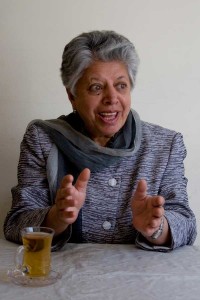
I’m now working on Suraia Perlika’s life story which tells of another woman also working for women’s rights and education, but from the Comunist side. She was one of the founders of the Democratic Women’s Organization which was supported by the Communists and also used as propaganda by them to show how much they’ve improved the lives of Afghan women. Ultimately, they imprisoned Suraia and put her on the “death list” but at the last minute she was pardoned by a rival Communist faction who had just come to power. She revived the Democratic Women’s Organiation as the Afghan Womens’ Union and gave herself the made-up name, Suraia Perlika.
Posted in Afghan Women's Project, AWP 2010, education, Other, Peggy Kelsey, political, Suraia Perlika, women | Comments Off on Suraia Perlika
Tajwar Kakar part 2 Life under the Communists
Friday, January 21st, 2011
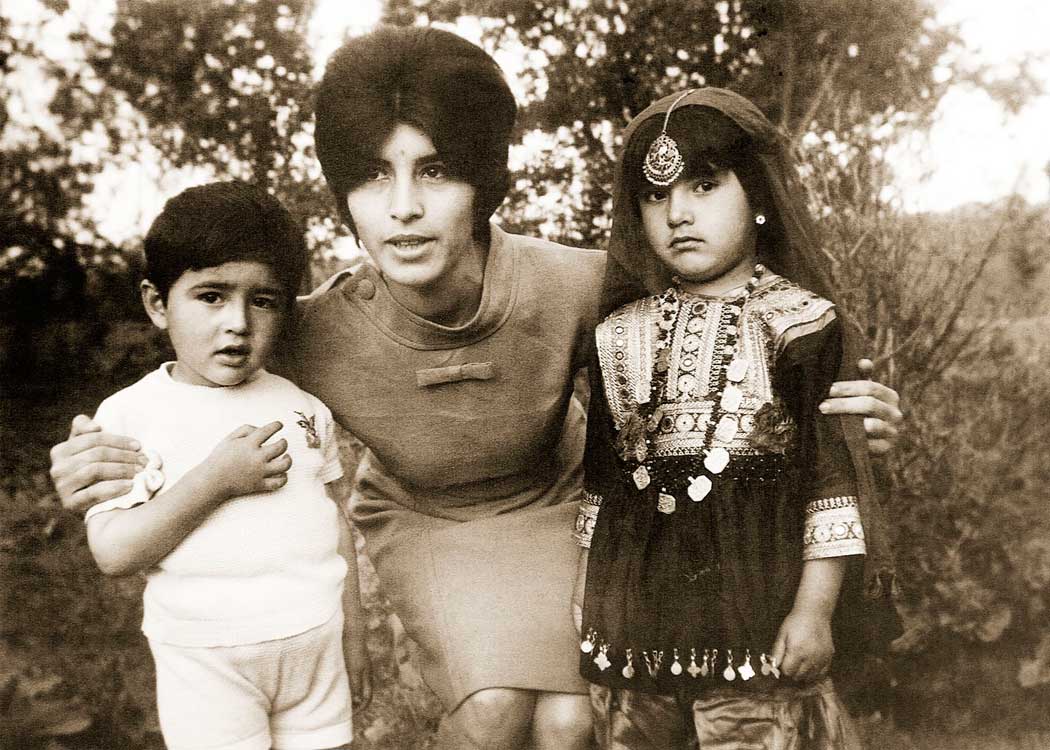 My mother engaged me when I was 12, I was married at 14 and had my first child at 15. My husband was Uzbek (which means that he spoke Uzbek as a first language and he had many customs I wasn’t used to. I was his second wife. He was a very powerful man and was always having guests over. So, every other night I had to prepare large dinners for them as well as keep up with my school work (I was in 8th grade when I married) and take care of my children. I never had any help, I did all the work myself.
Before the government changed, I had a normal life, a happy life. I finished my schooling and taught for 5 years in Kunduz high school. And after that I became headmaster. But when the government changed. and the king’s cousin, Daoud came into power the Communists began trying to register people. All of my husband’s family became members of the communist party. They especially wanted me to join because my father had been so powerful and so popular, But I rejected it. And so, I was the first woman who got fired from her job. For 3 months I stayed home but eventually they assigned me to another school and watched me very closely so that I couldn‘t contact my friends.
After a year, they sent me to Kabul and every subsequent year they sent me to a different school and gave me different subjects to teach. Every week they came into my classroom and pushed me to join the Communist party. They promised to give me a good position. They offered to send me to Russia or Poland to get my Master’s degree, but I refused it all, knowing that I would be forced to become Communist. They send me from school to school so I wouldn’t have a chance to make friends. But that was a good chance for me. I found a lot of my friends and my teachers and old students. During these 4 years they were arresting people twice a month . They arrested me in 1980. At that time, my oldest child was 14 and my youngest was 5.
In early 1980, whenever the Communists saw any young men they conscripted them and sent them to war. At one point they had arrested 150 men and asked each of them who was working for the freedom fighter women and they gave my name. Three people were witnesses saying that I was the head of women freedom fighters in Kabul. At first they put me in a KBG jail to do an “inquiry”. There I was tortured with electic shock. A lot of people died there. After a month they put me in another jail for a year. The whole time I refused to give any names or information and after a year I was released.
When they let me go, they made me sign a letter saying that if they find that I have any connection with freedom fighters, they will kill me. I signed that paper. When I got out they sent me back to Kunduz and I found that they had punished my children in a different way by telling them bad things about me. At the same time, the Afghan Communists were attacking villages, people’s houses, raping their women and killing their husbands and their children. So I became the freedom fighter leader in that city.
So, they sent me back to Kunduz and I found that they had punished my children in a different way by telling them bad things about me. At the same time, the Afghan Communists were attacking villages, people’s houses, raping their women and killing their husbands and their children. So I became the freedom fighter leader in that city.
Posted in Afghan Women's Project, Other, Peggy Kelsey, Tajwar Kakar, women | Comments Off on Tajwar Kakar part 2 Life under the Communists
Tajwar Kakar Part 1, Birth Story plus 2011 Update
Sunday, January 9th, 2011
I’ll begin 2011 with the amazing birth story of Tajwar Kakar, a woman I met on my trip in 2003 and again this past spring. I’d love to see her life portrayed on the big screen.
Tajwar Part 1 Birth Story
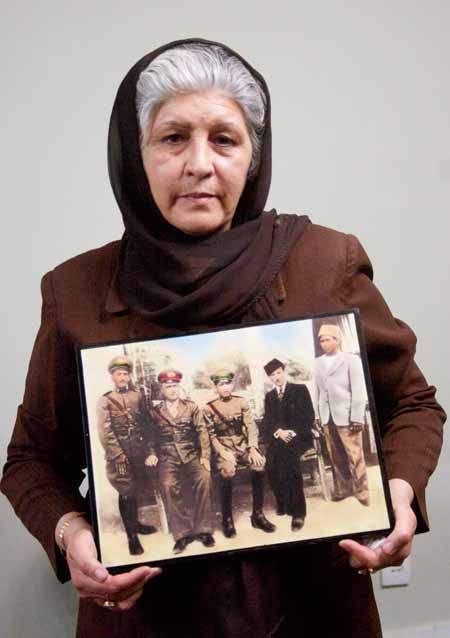
Tajwar holding a picture of her father (far left)
In 1948, Tajwar’s soon-to-be father was commissioner of the border between the Soviet Union and Afghanistan. The Russians* had gotten control of the Amu Darya River, also known as the Oxus, which runs along the northern side of Afghanistan, and were trying to make the border on the Afghan side of the river. “My father didn’t let them,” Tajwar told me. Six times before, Afghans had tried to negotiate a mid-river border, but had failed. “My father was brought from his post in Farah Province to meet with King Zahir Shah and head up the delegation. Before he left, my grandmother told him that my mother was pregnant. He told my mother that it doesn’t matter whether this child is a girl or a boy, but ‘if I get the river from Russia then it will be a lucky child for me. If I lose this river and Russia makes the border inside Afghanistan, this will be an unlucky child and I never want to see its face.'”
“So every time my grandmother prayed she would say ‘Allah, please help that man. This is an innocent child. When he says he will do this he will because he‘s a very strong Pashtun.’ My grandmother prayed every day that my father would get the river back. On the same day I was born he won back the river.”
“When he got the river he called to his people and told them to bring my child to the border. My grandmother said that I was too young but some people came and made a basket from branches and some very nice cloth. I was put inside and they took off for the border. More than 5000 people followed. When I arrived, my father put me in the boat and we went out into the river where he gave me the name Tajwar which means crown.”
“When he got back to Kabul, my father warned the king about Russia’s intention to invade Afghanistan and of his cousin, Daoud’s intention to help bring it about. Mr. Kakar was ignored, but his sympathies became known within the palace.”
“We moved to Kunduz when I was nine. Two years later, my father was poisoned by Daoud’s people because he was a powerful man and he didn’t support the Russians.”
*Tajwar always referred to the Soviets as Russians, but there were many Soviet troops from Kazakhstan as well as the other satellite states in addition to the Russians.
UPDATE
It’s been months since I’ve updated my blog. But with a new year comes a new determination to be more present in this space. 2010 brought my second Afghan Women’s Project trip to Afghanistan and its subsequent six months of interview transcription and image processing. Finally, my new presentation, Afghanistan 2010, a View from the Ground was crafted and debuted.
2011 will be the year of writing my book on the subject as well as giving presentations throughout the country. In addition to commentary on issues, I will be posting here in this blog elements from the book plus reviews of books pertaining to Afghanistan that I’ve read. And I resolve to post more regularly.
Posted in Afghan Women's Project, AWP 2010, education, Other, Peggy Kelsey, Tajwar Kakar, Uncategorized, women | Comments Off on Tajwar Kakar Part 1, Birth Story plus 2011 Update
Sunday, November 7th, 2010
It’s been a long time since I last posted. I’ve been very busy, focused on preparing the photo exhibit which will accompany my presentation, Afghanistan, 2010, a View From the Ground here in Austin on Nov. 19th at Ventana Del Soul in Austin. (78741)
Now I’m to the point of proofing the images and working on the word panels containing each woman’s bio and an excerpt from her interview that will accompany each of 25 portraits. This stage of the process has been gratifying and revelatory as I get a chance to step back from the mass of images and words and look deeply into individual eyes and take in their messages.
For example, I see the strength and determination in Habbiba‘s face while I read about the death threats she received during her time living in a Pakistani refugee camp. She and her sisters had started an informal school for bored young kids who were acting out but elders in the camp threatened to kill her if they didn‘t stop. She also started a small business in the camp, bringing in items from the bazaar in Peshawar to sell, which earned enough money to enable her and her family to move out.
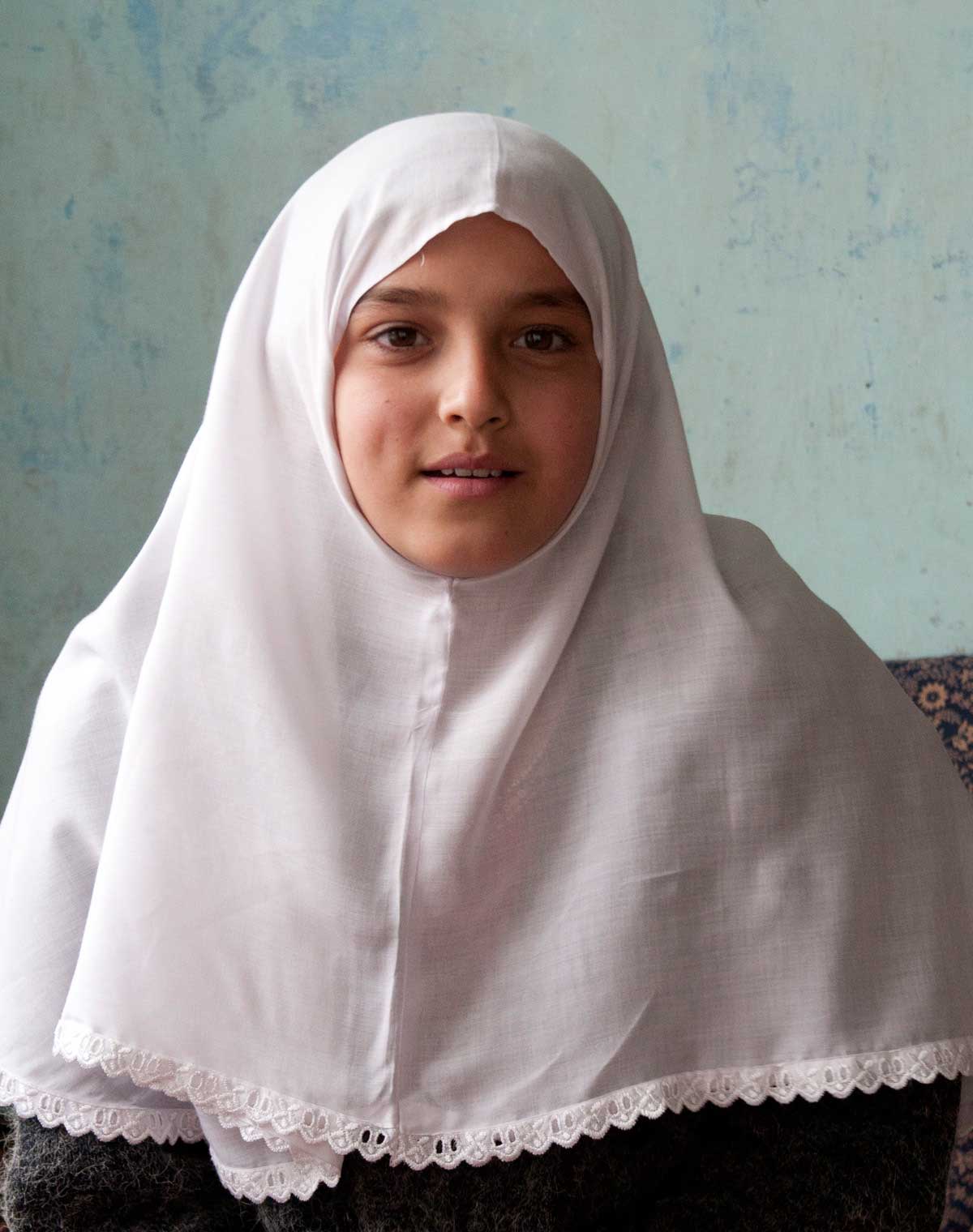
And there is the forthright look and single purpose of Rohina, who at 11 years old, is solely focused on her dreams of becoming a doctor and leading her family out of its hand-to-mouth poverty.
And Sakina, an 80 year old “internally displaced person”, (IDP) who returned to Kabul from a refugee camp in Pakistan. Her family couldn’t afford a house, so she now lives in an informal camp inside the city. I marvel at the determination in her face and the sparkle in her eyes.
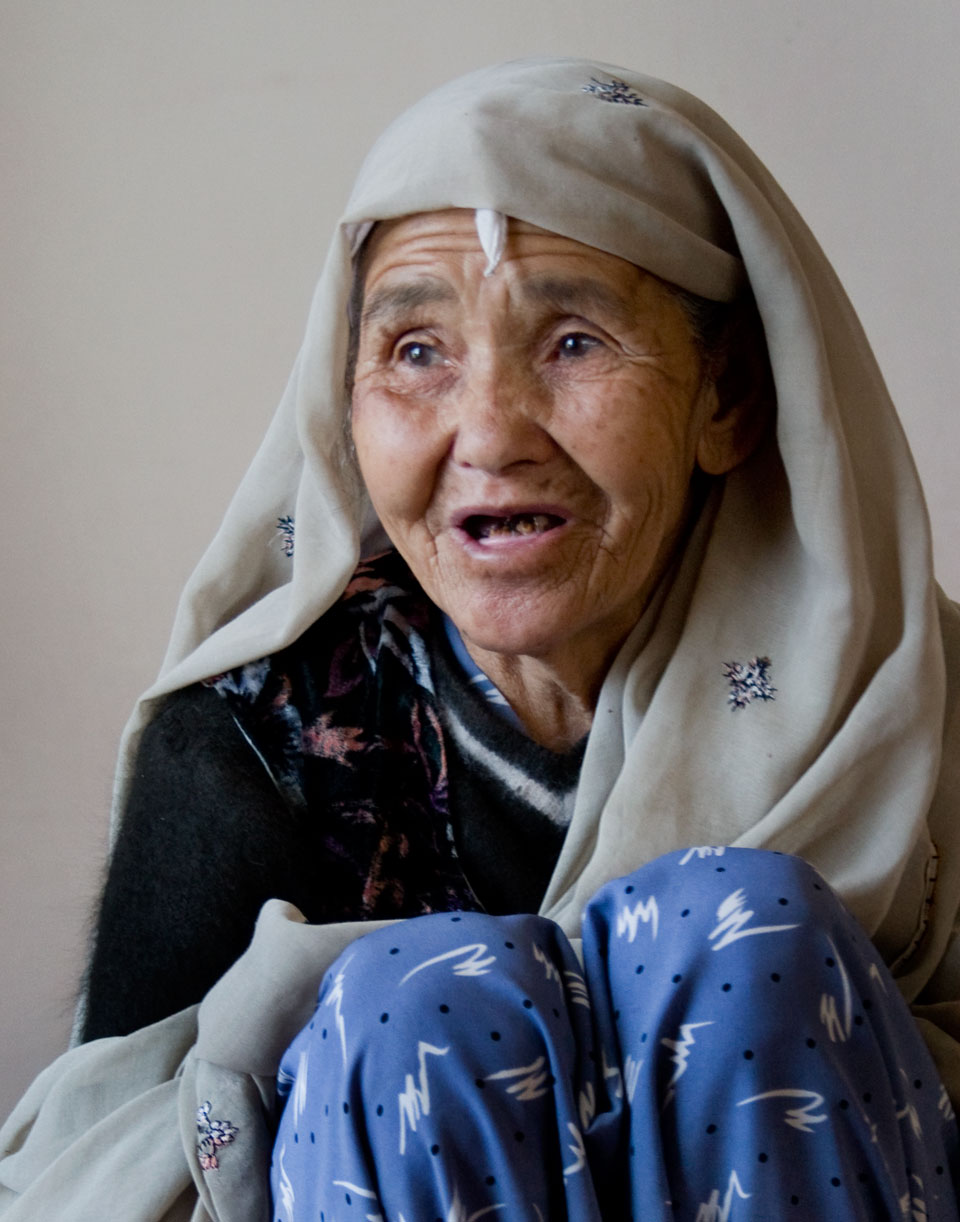
Sakina
In spite of her lifelong poverty and struggles with living in uncomfortable conditions and severe winter cold at her advanced age, she is still an active member of her family and complains that people don’t want to hire her to clean their houses because they think she’s too old.
To book the exhibit and/or presentation(s), email me at peggy@kelseys.net
Posted in Afghan Women's Project, AWP 2010, psychological health, refugees, women | Comments Off on
Commentary on the Aisha NY Times Article
Sunday, August 8th, 2010
Often glossed over in the story of Aisha, the beautiful 18-year-old woman who was disfigured as retribution for running away from her inhuman marriage, was that although it was a Taliban commander who ordered her horrific punishment, it was her husband (also a Taliban commander) who held her down.
This sort of human rights abuse has been going on since pre-history in the form of “blood debt”, a sacrificial attempt at holding the fabric of society together. To redress an offense, the family of the perpetrator gives a child in marriage to the wronged family. In Aisha’s case, she was married off to atone for her uncle having killed of one of her husband’s relatives. These unfortunate women are generally treated as slaves and subject to all kinds of abuse from their husbands, mothers-in-law and other family members.
The perpetrators of this crime against human rights were Taliban, but it didn’t happen because they were Taliban. As with honor killings, the custom of murdering women for destroying the perceived honor of their family, whether proven or only suspected, the blood debt is a means of restoring honor to the family and stability to the society at large. The father and/or brothers who carry it out are following the age-old customs of their culture. Even completely eradicating the Taliban wouldn’t put an end to the brutality of these practices.
Rather, the way to improve human rights in the long run is through rural education in areas such as the village Aisha came from. It’s great that a large number of foreign NGOs are currently working in Afghanistan, some even in remote provinces, to promote education and build schools. As crucial as it is to educate girls, transforming society through human rights education is also important for boys who will grow up to be the ones in control.
However, the best, most sustainable way for this to happen is via Afghan NGOs. Not only are they mostly more cost effective, but they are more likely to be accepted by local people and to weather the changes coming forth in the next few years. We can participate in this by supporting such organizations as The Afghan Institute of Learning (AIL), an NGO founded by Sakina Yacoobi steming from her work in the Afghan refugee camps in Pakistan. AIL’s curriculum, based on the Koran, teaches about women’s and human rights in addition to academics. They spread their work exponentially by training teachers in modern teaching methods and by focusing on opening schools in the rural areas where they are invited. (They have more requests than they can handle and more contributions can help them reach farther.) You can contribute to their work via their American partner, Creating Hope International.
Posted in Afghan Women's Project, Aisha, AWP 2010, education, political, Taliban, women | Comments Off on Commentary on the Aisha NY Times Article
Bamiyan Province, Part 3
Saturday, July 17th, 2010
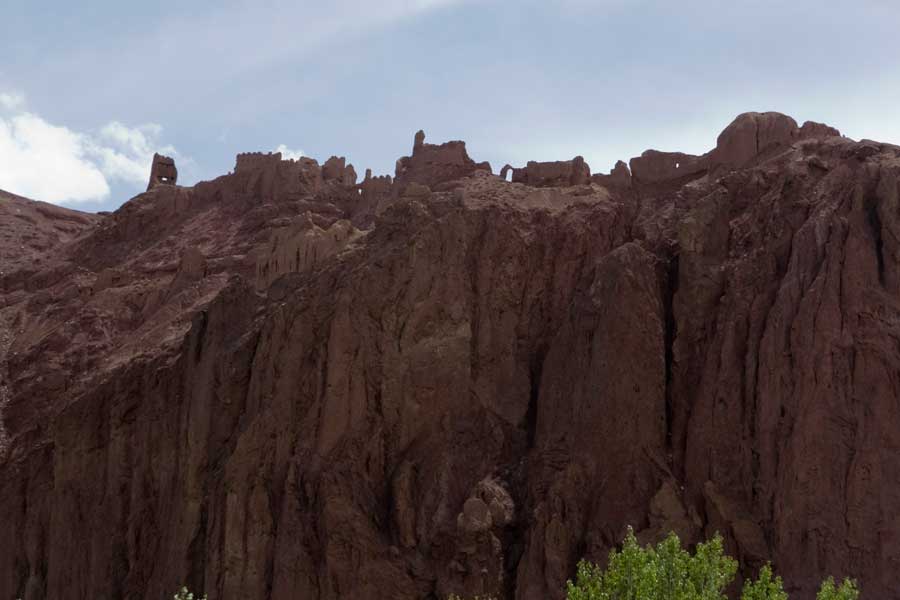
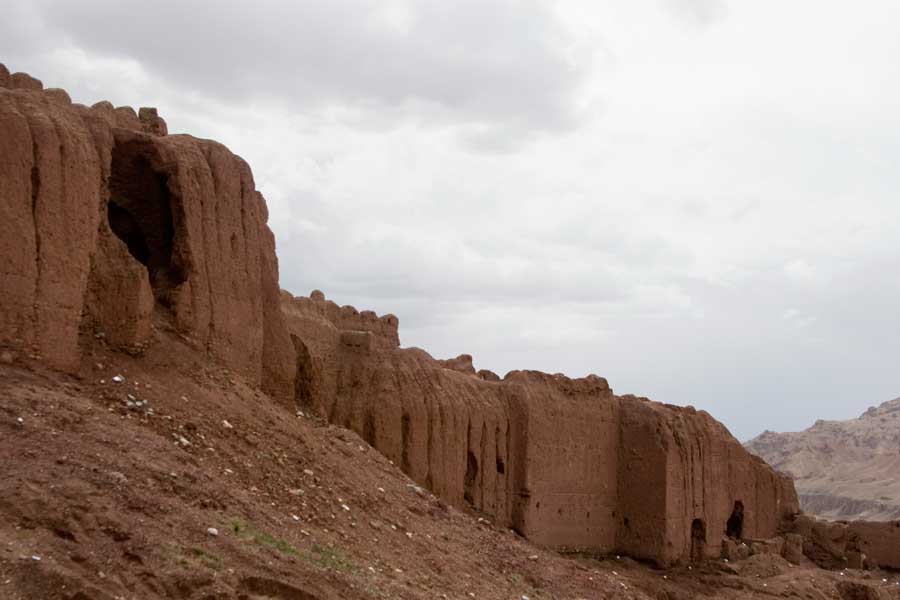
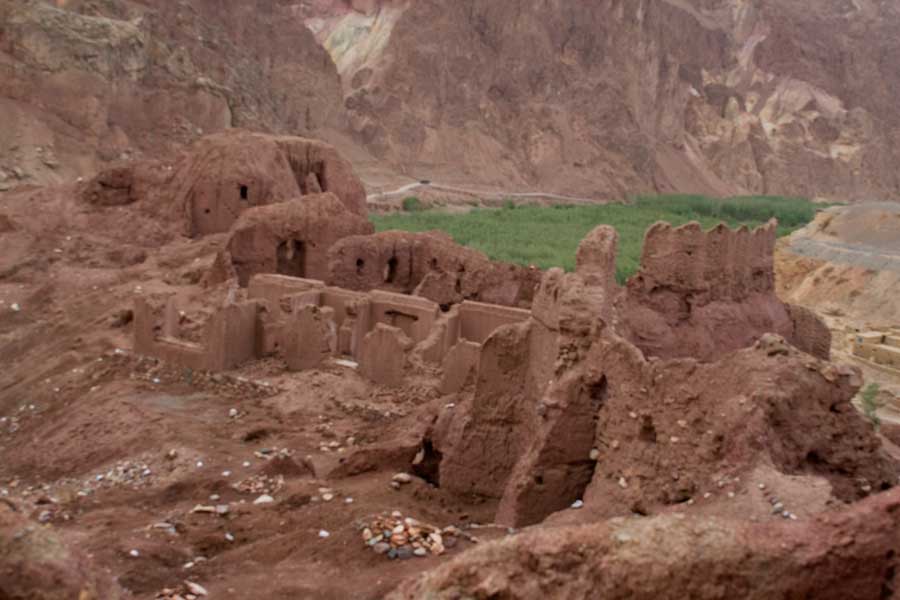
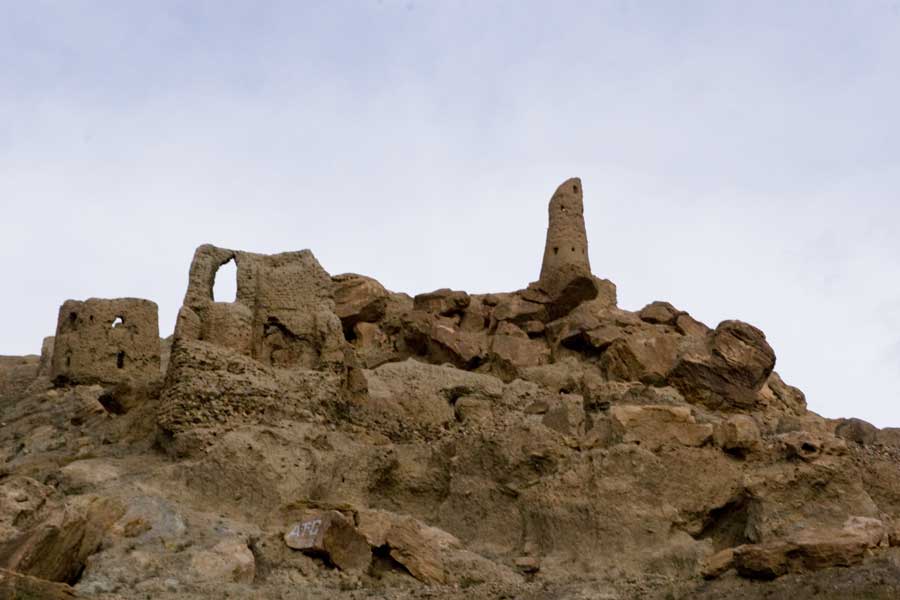
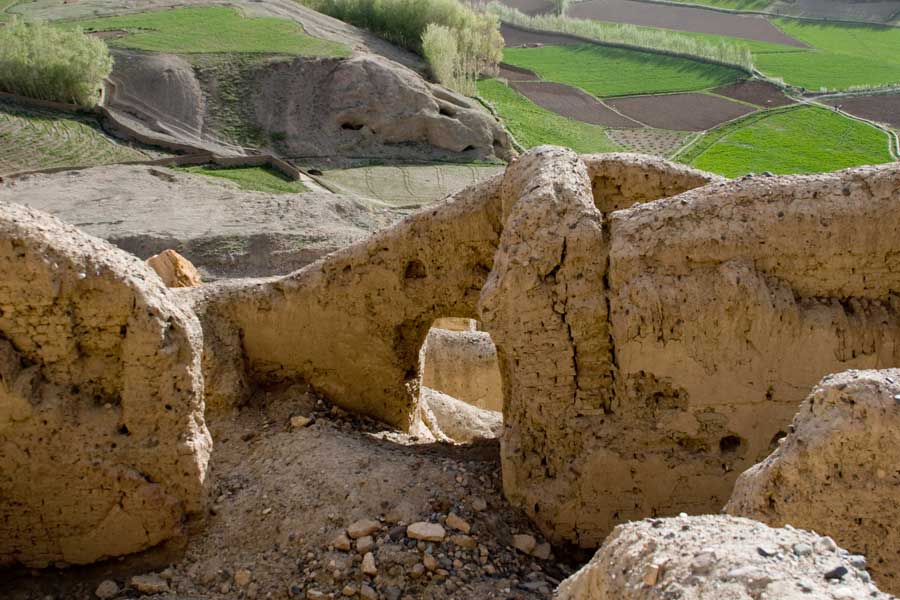
About 15km east of Bamiyan along the Silk Road lie the ruins of the ancient city of Zohak. Made entirely of red-mud bricks, it is also known as The Red City. Sitting atop a 350′ cliff of of red rocks overlooking the confluence of the Bamiyan and Kalu rivers, it guards the Eastern entrance of the long narrow Bamiyan Valley.
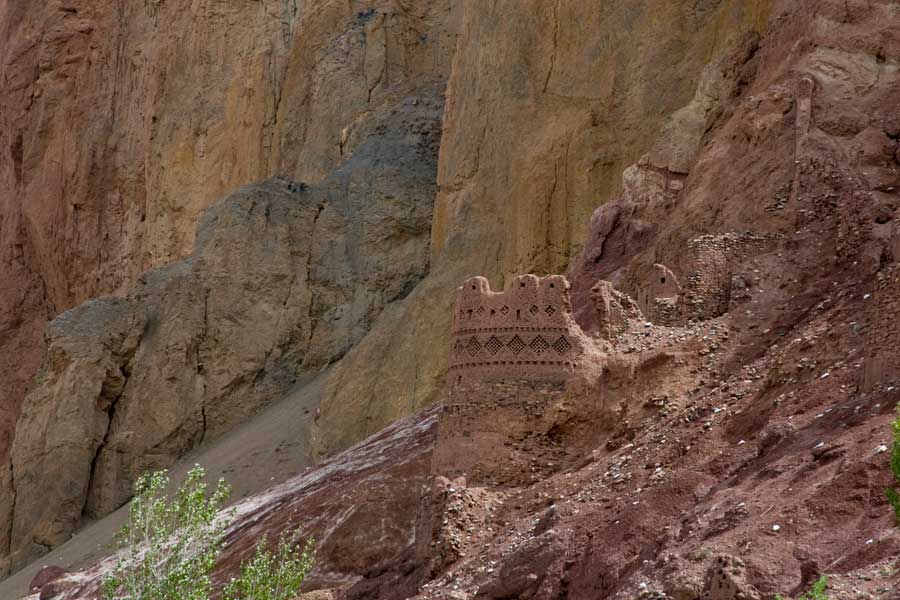
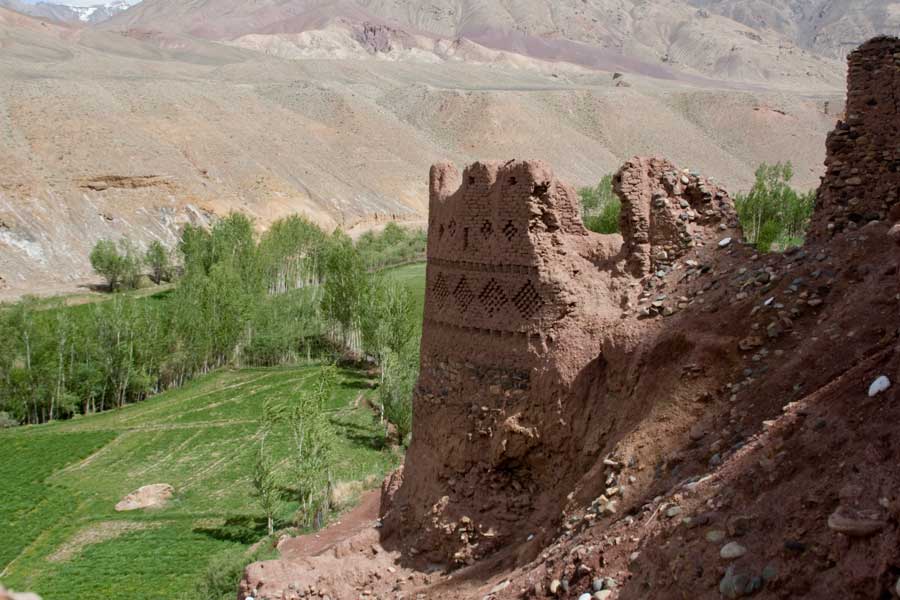
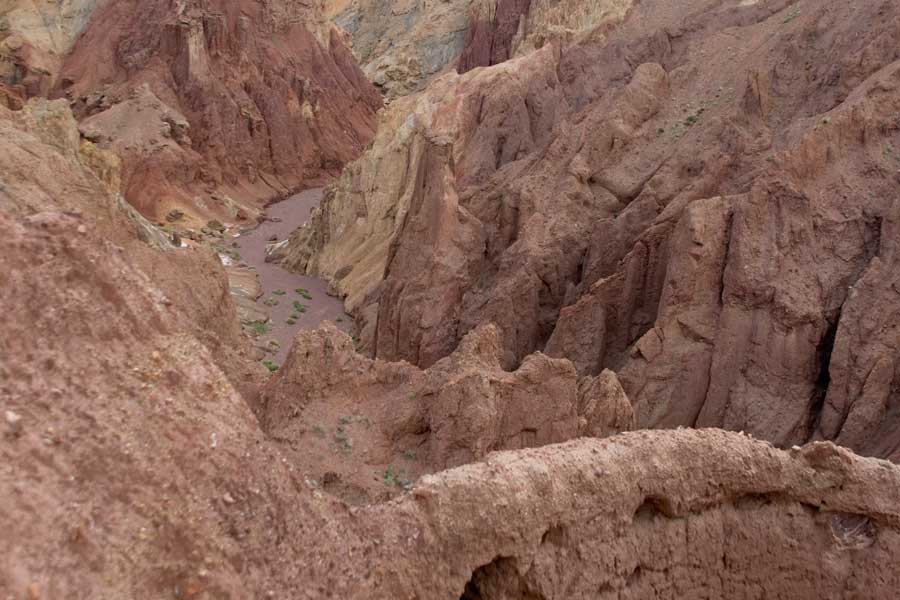
One would think that just being up so high would be defense enough, but in addition along the steep path were various guard towers and finally a tunnel one must pass through to reach the top.
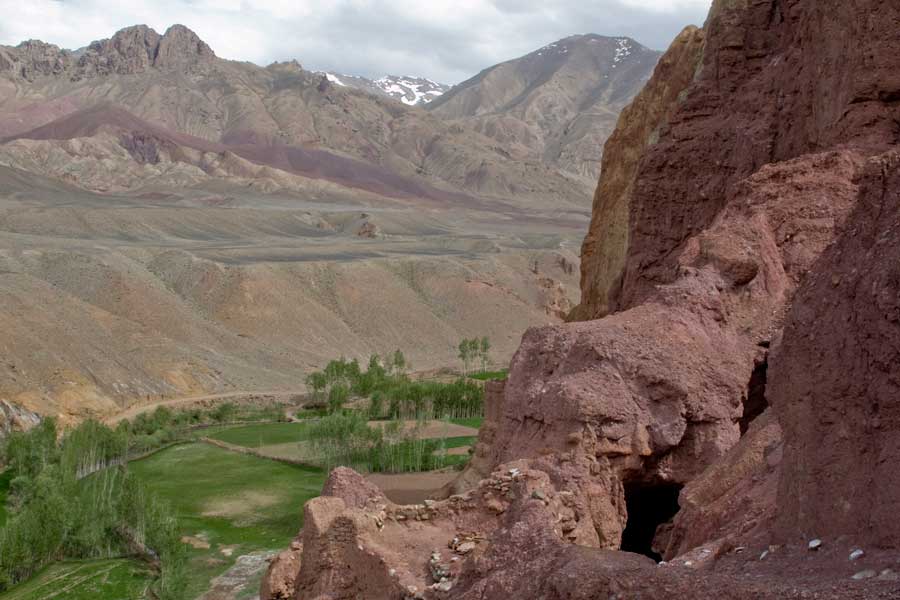
Although the present remains were built in the 12th century by the Shansabani Kings, there is also evidence that during the time of the Hephthalite Huns in the 6th century, there was already a massive complex here. In fact, I saw pottery shards from the Kushan Dynasty period, which was dominant in this area during the 1st-4th centuries. In modern times, it became a Mujahidin stronghold during the war against the Soviets. At its peak, 3000 people resided here.
The story of how the city got its name was best told by Nancy Hatch Dupree:
“Zohak first appears in the Shahnama as a noble prince of Arabia, a devoted son well-beloved by his people. He became, however, possessed of the Devil who induced him to usurp his father’s throne whereupon the Devil appeared disguised as a loyal subject who asked to kiss the new king on the shoulders in token of his complete submission. No sooner had he done so, and vanished, than two black serpents thrust their heads out from where the kisses had been placed. Attempts to cut them off only resulted in their immediate return and their increased demand for human brains, the only food they would accept.
At the same time that Zohak was being seduced by the Devil, civil war broke out in Iran and Zohak marched in as the champion of one faction and was enthroned as the emperor of Iran. For a thousand years his rule brought terror and chaos to the land, but then the hero Fraidun was born. After many escapades, Fraidun finally succeeded in taking Zohak prisoner whereupon he took the dragon-king to a far off mountain peak and left him there to die. The Shahnama ends the tale here but, typically, Afghan legend goes on to elaborate by saying that, deprived of their daily meal of brains, the serpents turned on Zohak, bit into his scalp and fed upon his brains until he died.”
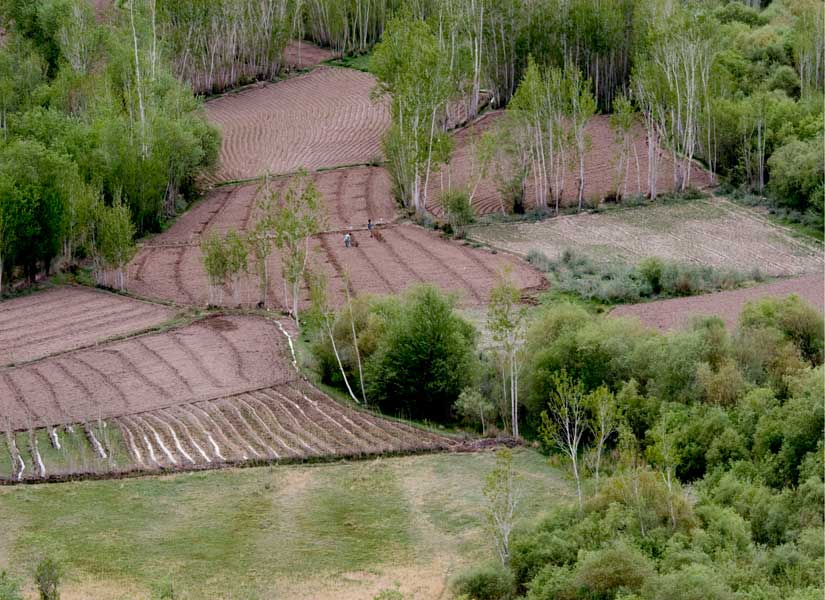
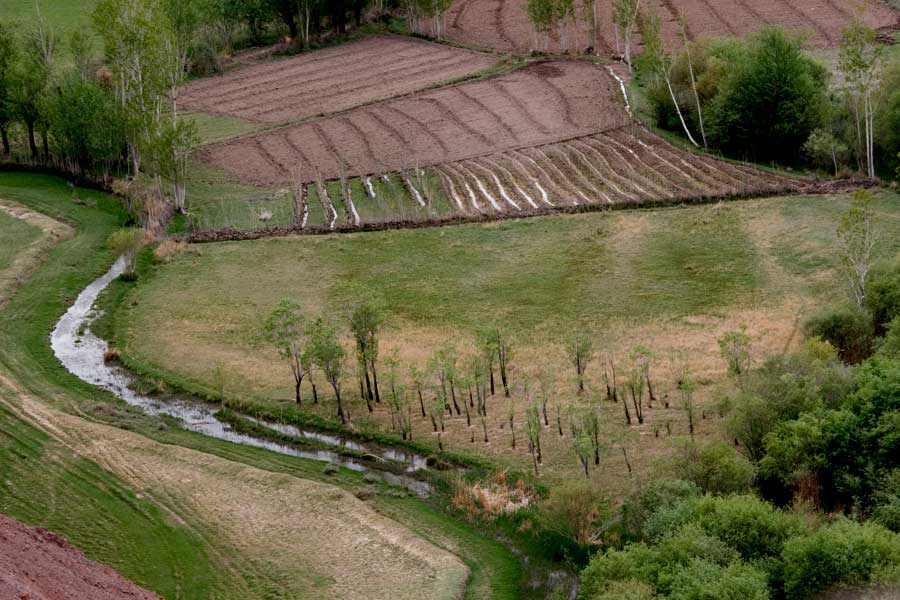
My guide told me that people believe that this city with its fertile valleys was the royal abode of Zohak.
I’ve read that in 1222, Genghis Khan sent his favorite grandson to deal with the Shansabani kings who responded by slaying the young general. As revenge, Genghis sent his warriors to storm the citadels. Every living thing in the valley was slaughtered. My guide told me that this actually happened in Gogola, The City of Screams which overlooks the Buddha site in Bamiyan.
Posted in Afghan Women's Project, archeology, AWP 2010, environment, Other | 1 Comment »
Bamiyan Part 2
Friday, June 4th, 2010
[Sorry to take so long to get this post up. Now I’m back in Austin and beginning to go through my interviews and photos. It’s a mountainous task! I will continue to write as I go through this process.]
Bamiyan means “shining place”. It’s holy for Zorastrians as well as Buddhists.
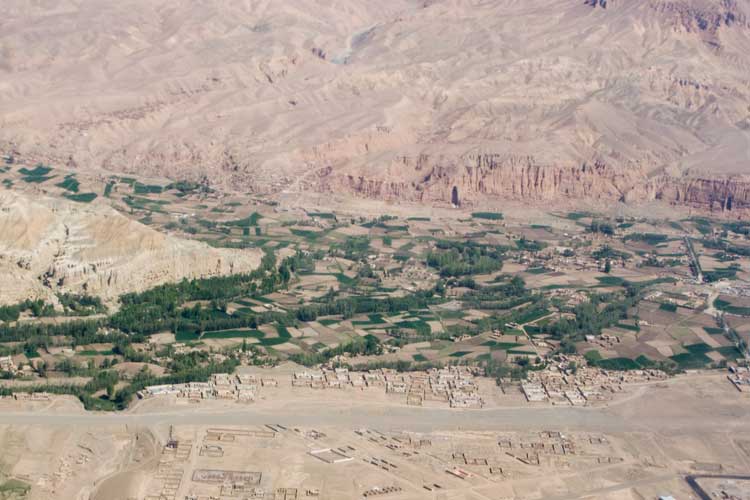
The Buddha cliff
The cliff with the “Buddha caves” dominates the landscape of Bamiyan City. It runs along the ancient Silk Road between the the Hindu Kush and the “Baba Mountains”.
Abbas, a well-versed guide from the Agha Khan Foundation cultural Center, showed me around.
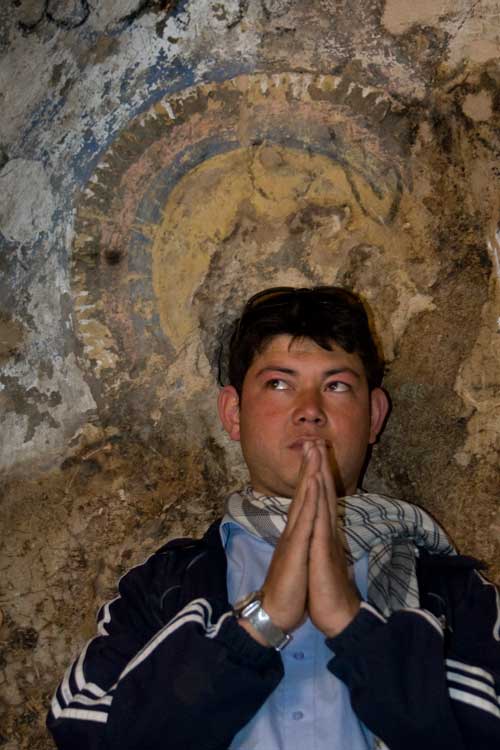
Abbas
Bamiyan was chosen by the Hephthalites as the place to settle because of the mountain barriers and strategic defense points overlooking the valley, it’s location along the Silk Road and the conglomerate cliffs that could be easily carved into housing.
The worst war (of the Soviet, civil and Taliban) was the one with the Taliban. There wasn’t so much fighting during the “Russian times”. The Soviet army perched on the few high places and easily controlled the area but mostly, people were allowed to live their lives. The Taliban period was quite bloody, however, as here the conflict included racial animosity (Hazara vs. Pashtun) as well as a fight between the Sunni Taliban and the (to them) heretical Shia. Hazara fighters holed up in the caves, which had inner passages from one to the other. 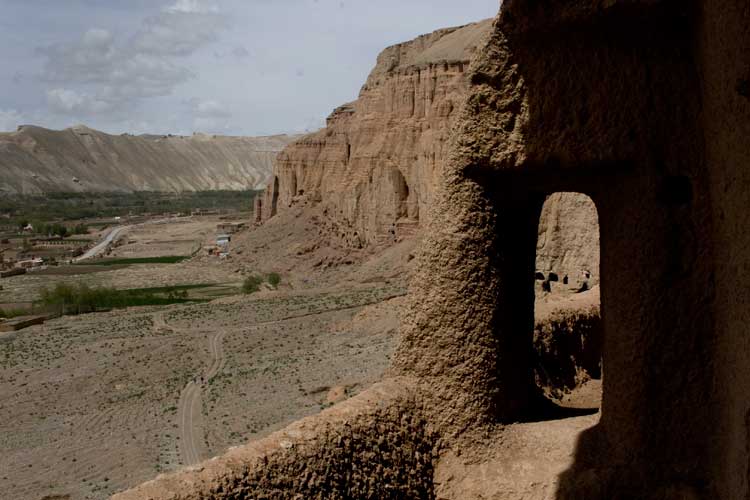 In some areas, water was also channeled inside. During and after the wars, 3000 or so families were living in the caves which kept them cool in the summer and relatively warm in the 6 months of harsh winter.
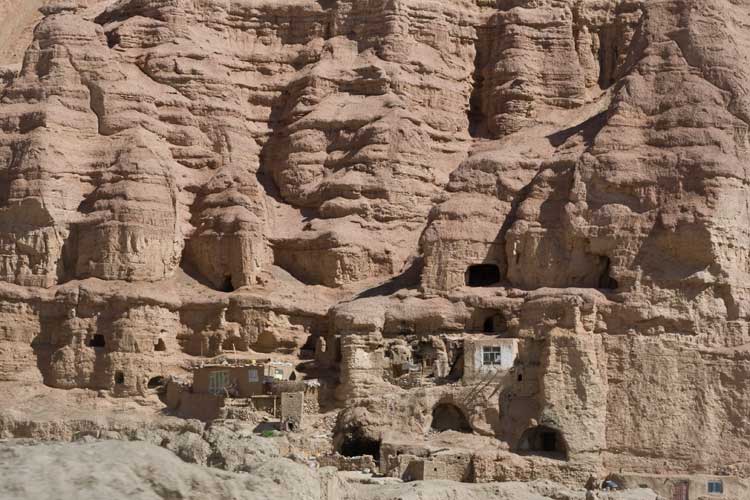
Cave houses
I was surprised to find that all of the 12,000 caves in the Bamiyan area are man made, the ones along the “Buddha cliff” hand dug at first by the Buddhist monks, and later by regular people to make their houses. Buddhists begain moving into the area in the second century and by the 5th century, 2,000 monks resided there
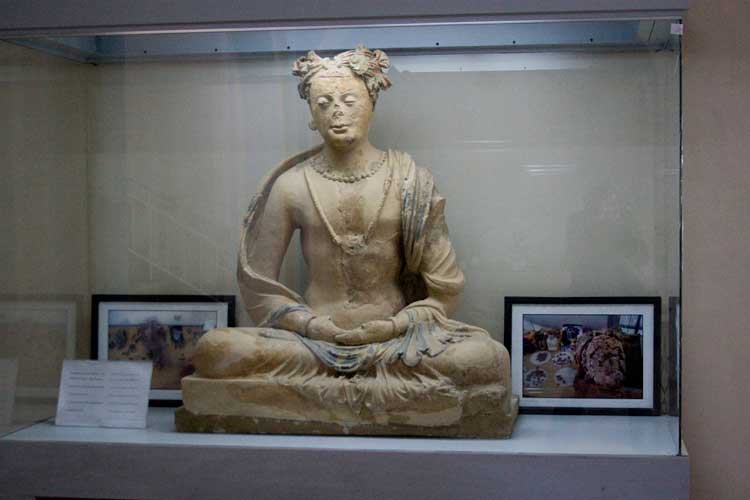
A Buddha now in the Kabul Museum
It took a full century to carve the Buddhas. The large one was covered with gold and diamonds and both were painted. They found heads of small Buddhas and small stupas below the wall with the Buddhas.
This excavation progresses in June and July when Professor Tarzai is free from his teaching duties. When he’s not there, the site is lined with plastic and filled in with dirt. 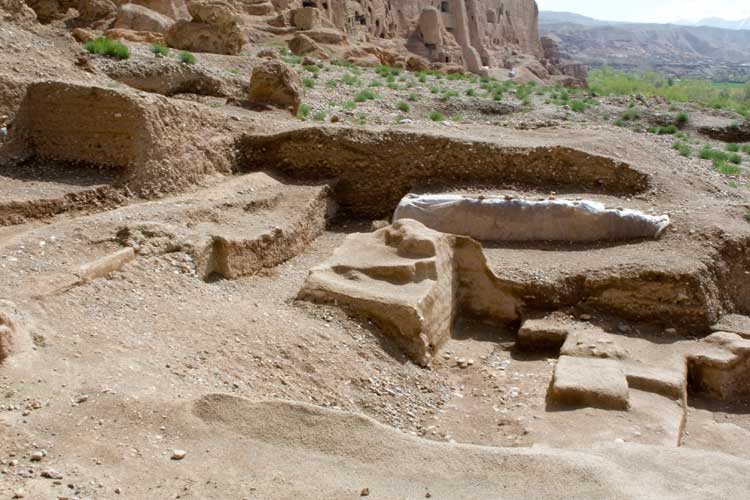
In Greece and Rome they found copies of a map of Bamiyan. It mixes Greek, Indian, Byzantine, Iranian Sasanid and Chinese architecture. It was made at the same time, using the different styles.
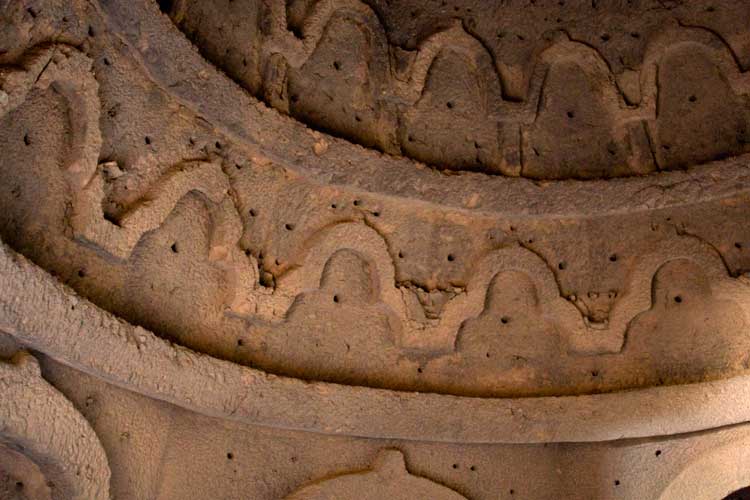
Interior carvings
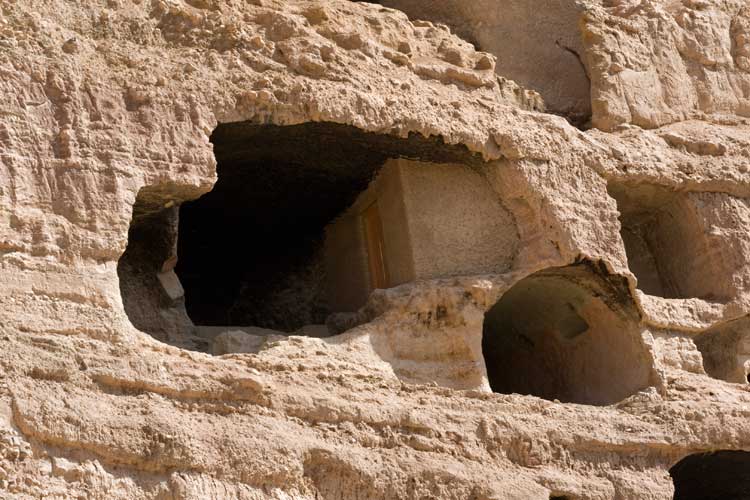
Locked cave paintings
In this place with doors locked by UNESCO, the paintings are even better. The blue color was made of ground up lapis lazuli stones. The green was colored by a tree, yellow from herbs, and poppies made the red. These colors were mixed with either walnut or poppy seed oil. These date from the 5th to the 9th centuries, before oil painting was done in Europe.
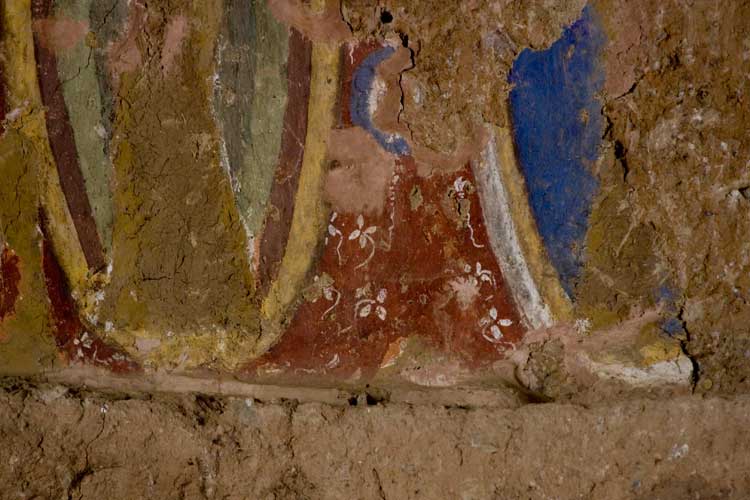
Buddha feet
Most of the Buddhas statues were just carved out of the soft stone cliff, but parts of them were modeled using a plaster of mud mixed with straw. The arms, which were also added, were secured in place with these
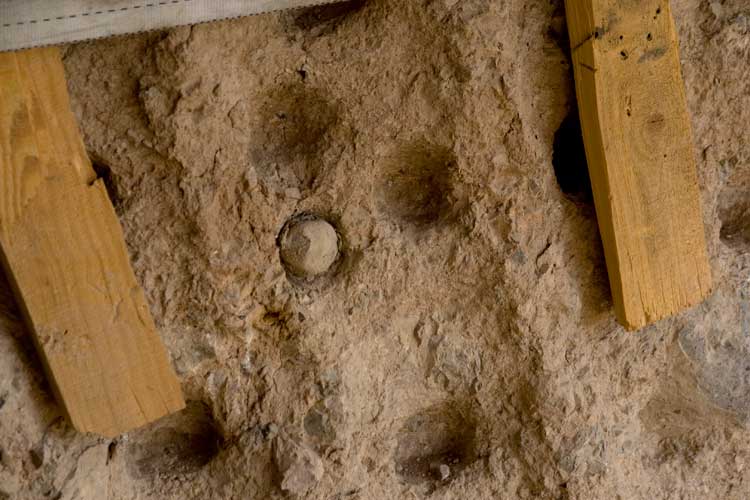
pock marks” which allowed the mud-glue and wooden pegs to adhere to the sides of the grotto.
The Taliban had a hard time destroying the Buddhas. First they shot at it, and when that didn’t work, they used dynamite. They blew charges three times a day. It took 1 week to destroy the small Buddha which was made of softer material and it took a month to destroy the large one.
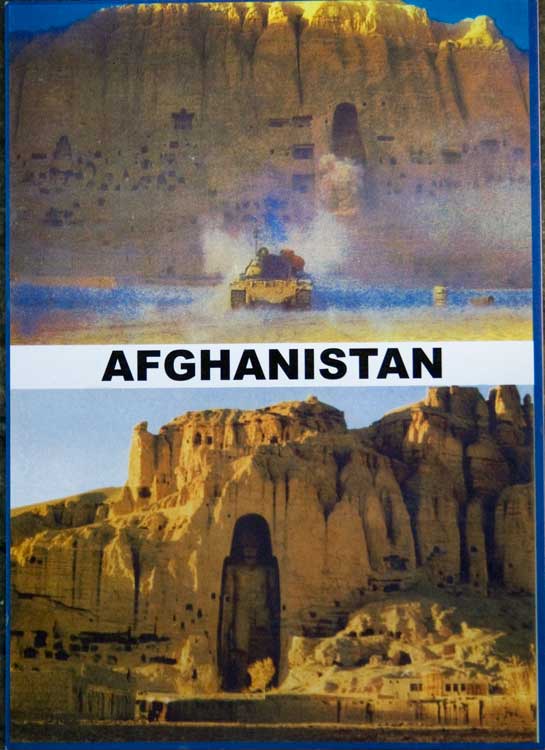
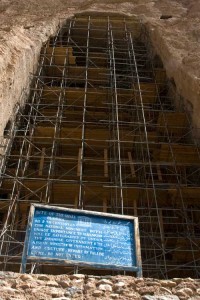
Once the Buddhas had been blown up, a lot of the rubble has now returned to dirt.
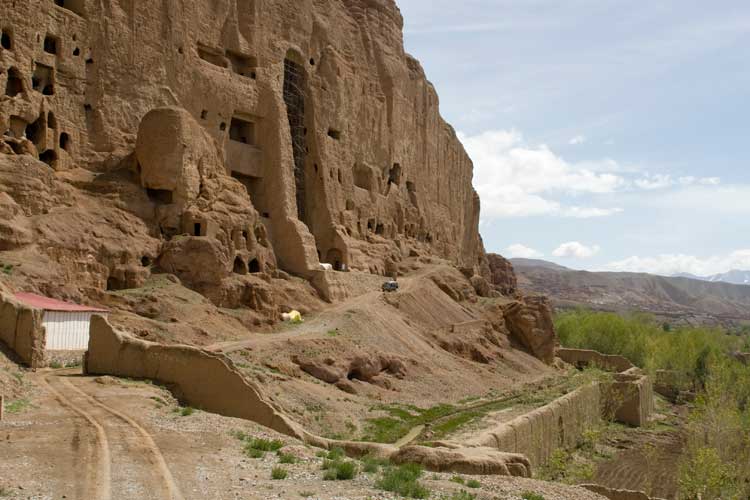
The dirt below the Buddha remains from the statue
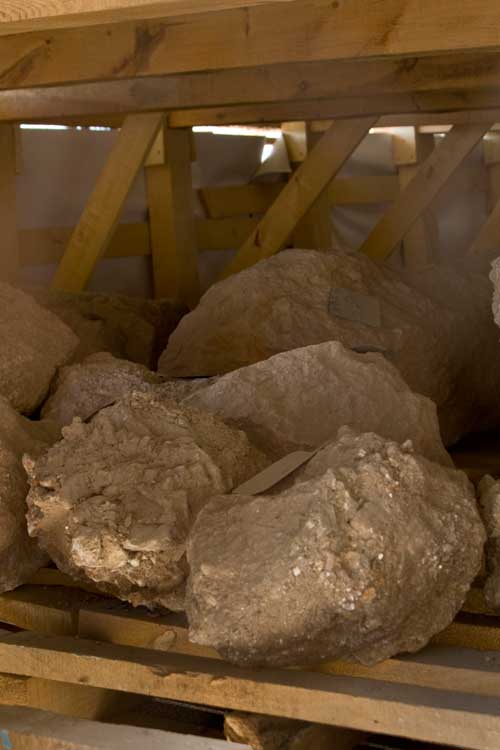
Buddha pieces
The plans are to do a partly fragmented reconstruction.
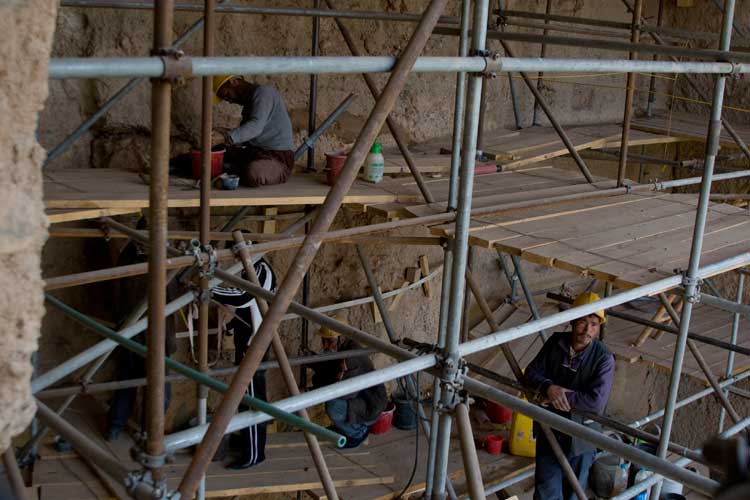
Here they are stabilizing the rocks. In this phase of the reconstruction, they are painting the rocks with chemicals to help solidify them.
In addition to destroying the Buddhas, the Mujahadin and Taliban also added their graffiti to the paintings
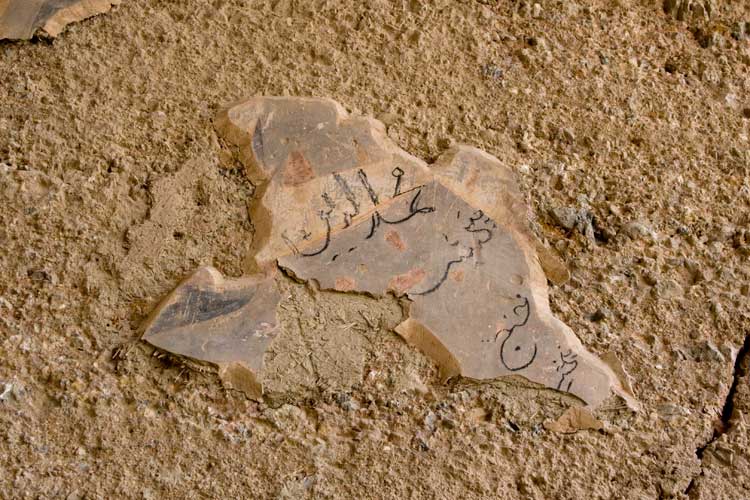
Graffiti on Plaster oil paintings
and had fun in the kitchen putting footprints on the ceiling.
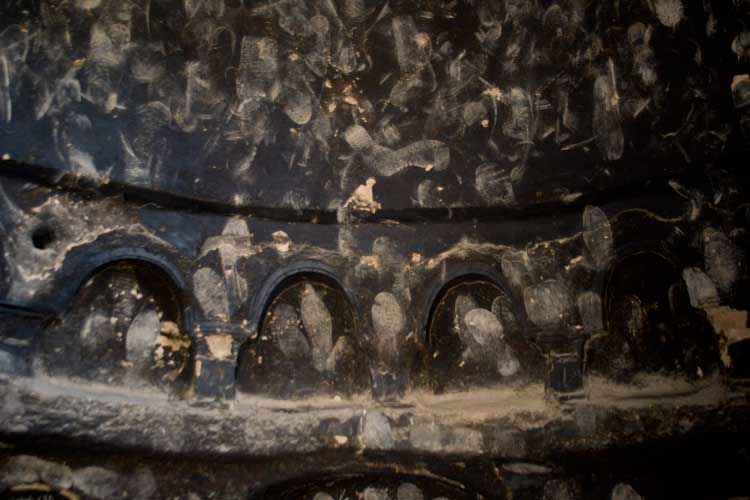
footprints
As we were walking through the caves, Abbas found this crumpled handwritten piece of the Koran stuffed in a crack in the wall. We stopped at the tourism dept. on the way out to turn it in. They don’t know the exact date yet, but it may be several hundred years old.
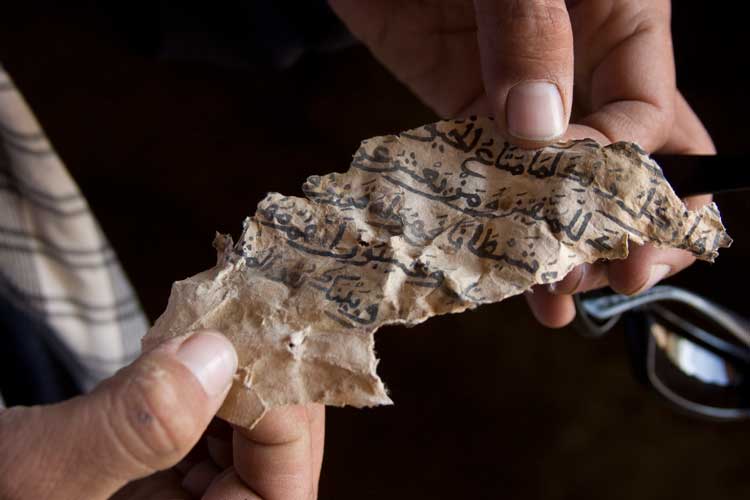
Posted in Afghan Women's Project, archeology, environment, Other, tourism | Comments Off on Bamiyan Part 2