Who Gets to Define Feminism?
September 2nd, 2014
Thought I’d share an essay I wrote and posted on the Voices of Women Worldwide website in response to a comment on an article by Ms. Leymah Gbowee, a Liberian social activist. The commentator was chagrinned by Ms. Gbowee’s adoption of an interpretation of feminism that differs from that of the Western mainstream.
Essentially, the issue is who gets to define feminism. It is my belief that while women should band together to support each other in effecting the empowerment of other women, what exactly they support will necessarily be different in different cultures.
Empowered African women like Ms. Gbowee and Afghan women such as many I interviewed (you can read what they have to say in Gathering Strength: Conversations with Afghan Women) define their desired feminism in terms that fit them and their perspectives. When their brand of feminism suits them and has a chance of being accepted by other women and men in their cultures, who are we in the West to tell them they’re wrong? That’s cultural imperialism.
The commentator asks: “…Are we not all women..with the same needs for equality..seeking the same changes...” No, we are not. Women have the same need for RESPECT and equality under the law, but many culturally liberated female activists (like Ms. Gbowee) around the world believe that men and women have different roles to play in society and ALL of societies’ roles (and genders) should be respected equally. The equality that we have the same need for looks different in different localities, and the desired changes can also be also different.
In my mind, feminism’s goal should be to empower women to be the best they can be within their own contexts. It should be flexible enough to respect different perspectives about what is most essential to that empowerment. When it demands that all feminists toe a certain “party line” then it is disempowering and disrespectful.
If the feminist movement needs a set of common beliefs, those beliefs should be agreed upon by empowered women leaders from around the globe. Grassroots leaders as well as political leaders from different social classes and different religious contexts should all be given an equal voice. Western feminists should not dictate to them nor the world what constitutes “real” feminism.
Although our perspectives and aspirations are different, we can still be unified under one feminist banner. We should support all women in what they see as their best path to liberation as defined by themselves.
We can also observe that peoples’ perspectives change as society changes. Deep and lasting social change is a slow process, one that works best step by step. Once women are given their value and worth, then they may choose to seek changes toward gender neutrality since they will then be viewing it from a different context. They should also be free, however, not to choose it and still call themselves feminists. This gives them their power and women should support what gives us our power.
Posted in Other | 1 Comment »
Guest Post From Aysha, a student in a Kabuli high school
January 12th, 2014
Aysha contacted me asking if I would edit her story about how she helped her classmates with some of psychological issues.
Aysha is an example of the younger generation in Afghanistan who are eager to improve themselves and rebuild their country. Aysha’s story is interesting because she shares her thought process as her seven-day project unfolds. Please leave comments for her below.
And now, I introduce Aysha…
Salaam Alikom means peace be with you.
We Muslims say this so that the person we are talking should know that he/she is safe with us and we mean no harm for them..
My name is Aysha Mirbacha and I study in Al-Fatha High School class 11. I live in Kabul, the capital of Afghanistan. My first day in Al-Fatha high school was in the year 2008. I didn’t have any friends, but at that time I did not lose myself mentally. I would just go to study and come back home. As time passed I found many friends, and they would talk with me and meet me, but one day I recognized that they never said that I was happy. In fact, they said it seems like I feel pain and am unhappy.
I thought: please kill me, my life means nothing. I started thinking why, that’s not normal. They helped by talking and sharing feelings. I start to think positively, but I knew that was not going to help. They should start thinking positively too.
MY SEVEN DAYS
Ever since I was younger, I learned and heard one thing: Be like a girl, don’t go out, don’t talk to strangers, you don’t need friends.
But then I said to myself “there is a better world, and if I know that then others should also”. I was thinking of what to do, how to help, and then I learned about depression on online websites and gathered answers to all my questions. In school, I talked to my teachers and one of my classmates. I started researching, and I wanted to show them that what are they doing and thinking is making their problems worse.
I had 7 days only because our exams were in 25 days.
Day 1_
I was thinking that I can’t do this alone. I need help.
One of my classmates, Shayesta, came and asked me, “Aysha what is the problem? Can I help you with it?” I invited her to join me, and she said “yes I would love to”. She made me very happy. Shayesta said, “keep on with your research and I will see what I can do.”
Day2_
I said to Shayesta: “This is too much pressure on me in 7 days. I can’t do this.”
She said to me: “Aysha, stress doesn’t solve anything.” I had my computer and Shayesta told me we can do this. I will find answers for the stress problems from the side of Islam because we all are Monotheists and we believe in one God. I will search using that strength and you should search from science to see what science can prove.
I told Shayeata that she solved all my problems once we both were alone.
No one was there to help us but we didn’t lose hope. We worked together and talked to our teachers and classmates – people I knew or even those I didn’t.
I was worried and I said to Shayesta: “what if the principal doesn’t accept our project?”
She said, “Aysha we aren’t doing anything bad, we are helping. They won’t say ‘no’ to us. They will give us a chance, don’t worry at all.”
Day3_
We were working on our research and thinking how to sort it better. I was in my computer lab since bringing computers to school is not allowed by my teacher.
She asked me: “what’s in your hand Aysha?” I said it was a computer and that we are working on a project about Afghan girls’ stress. I suddenly said that students have family and environment problems which prevent them from studying.
The teacher said that it sounded like a very good project. The teacher asked how she can help, and we were a little shocked!
She then said that we should give a conference about it and she would find a projector for us to use.
Sayesta and I were amazed.
Day4_
We had 3 days only. Time was passing so fast, and I found out how precious time is. We were working and praying that Allah may help us. But we faced a huge problem to meet the deadline.
Shayesta told me she wished we hadn’t done this at all and she didn’t think we can do it. I said yes we can. If you and I started this, we will finish it. I wasn’t sure about it and tears came out. I wiped them fast so she would not understand my doubts.
We decided to make question sheets so by writing we can see our problems. We decided that this Friday we would stay home and make our questions and then print them. Shayesta said to forget about it, we are not even ready for our conference. I told her to leave this responsibility to me.
Day5_
I was at home with my family helping my mom and sisters and brother with daily work, and during the evening I had time to work on my question sheets. I completed my writing and I practiced for my conference. Everything was going well until morning sunrise when I went to school. I was so tired. When I met with Shayesta she told me she wasn’t coming tomorrow since she had to work at home. I couldn’t do or say anything because it’s her family, and she may have personal problems.
I told her to be here on Monday for sure, but today we will practice. We went to the principal’s office we told her everything about our project. She was very happy. The principal also gave me a movie. She told me I should watch this and that I will find many answer since the movie was about the secret of happiness.
Then, we used our school printer for copies of the question sheets, but we weren’t allowed to print all we needed. We asked permission for the conference in school and it was granted so we were very happy. I felt like I was flying. We both were running and went to class when one of our teachers called and said she wanted to help us with this work. She led us to our school library to make 100 copies of the sheets, and believe it or not, I have been studying for four years and it was my first time in the school library.
She copied the question sheets for us, and Shayesta told me that our problems are getting solved.
Day-6
Tomorrow was the big day for me and Shayesta, and we were definitely ready.
Everyone wished us the best of luck including my teachers and classmates. We took the hall key and went to assemble the chairs, fans and I checked the mic. It was working well but the projector was not working. We tried our best but it still didn’t work. Some of my classmates came and we checked all the wires, but they were all broken. I asked for help to re-join them and then the projector worked. It was unbelievable!
When everything was ready for tomorrow, Shayesta told me best of luck tomorrow is our day.
I just smiled and walk away to class.
Day-7
Finally, it was the day we had been waiting for.
We both went to the principal’s office for the key, but the principal suddenly said that we were not allowed to go in the hall and give our conference! We were both shocked I asked why she didn’t tell us before.
We had worked hard on this project. This is not fair! Shayesta and I both were about to cry. We thought everything was done. When I turned my head, I saw my teachers and I ran to them but when they talked to the principal she didn’t change her mind. Shayesta said we are wasting time.
Walking in the stairs, I saw my teacher that had helped in the library and I rushed to her and told her everything. She went to the office and gave us the key. All my classmates came to help me and Shaesta went to call the students from other classes. Some went to ask teachers to come. So the conference got started.
At the start the announcer started her talk about our title and why are we giving this conference. Students and teachers liked the title and they said it was helpful. After the announcer and Shayesta finished, I started my speech. I was a little shy and scared because it was in front of hundreds of students and teachers. I start to wipe my sweat.
But at the end, everyone stood up and clapped for us. The feeling was perfect. After that many students came and asked me for help. When I finished Shayesta and I were surrounded by many students. I didn’t understand what they were doing and Sonam, the announcer, said they want help from me. My classmates came and asked questions one by one.
They said they felt like they were born again with a new life, happiness, love and everything beautiful in this world.
After 3 days, we were still working to help students who wanted to talk to the principal. The office called us to say we would be rewarded with a certificate. Shaysta, Sonam and I were very happy. I was proud to be me. I felt good and peaceful to help others girls around my school environment and I am looking forward to helping them more
Posted in Afghanistan, Aisha, education, Other, women, writers | 1 Comment »
Print on Demand vs. Offset
December 4th, 2013
Posted in Other | Comments Off on Print on Demand vs. Offset
Karzai’s Failures
September 8th, 2013
An article on peacewomen.org listed numerous ways that Karzai has failed as a leader and especially in his mandate to improve the lives of his countrywomen. But the article only highlights Karzai’s more recent failures to support women. A complete accounting would require volumes.
It is common these days to lambast Karzai for his back-peddling on women’s issues. Afghan women have sadly come to realize that they can’t rely on him nor his government to stand up for them. Fortunately, many Afghan women are standing up for themselves.
Naheed Farid, the 29 year-old MP who won the most votes of all female candidates says, “I could not believe that I was able to overcome the conservative ideology of my society and receive the religious votes. I was welcomed by my generation and many youth voted for me.” ()
There are many progressive Afghans (men and women) working for women’s rights. They form a counterbalance to the increasing fundamentalism in the government. One organization is Afghanistan 1400, a mixed-gender group dedicated to “mobilizing and creating a political platform for the new generation of Afghanistan. It will empower the new generation to partake in Afghanistan’s political, social, and economic development.” Young Women for Change is another of many such groups, as is the Afghan Youth Peace Volunteers.
We rank and file outsiders can have little influence over Karzai. From everything I’ve read and the Afghans I’ve talked with, he is a weak man with little power who sides with whichever way he senses that the wind is blowing. Rather than wringing our hands over his failures to protect women, we need to support the Afghans who are working to turn the tide of fundamentalism. We can connect with and encourage them online, but it is also vital that we support their efforts monetarily. In addition to the organizations mentioned above, education with a human rights component has the best long term chance to transform the society. With 42% of the country’s population under the age of 14, there is great potential for the future reform of misogynistic traditions. The Afghan Institute of learning is one organization making a lot of difference in rural areas and Ayni is educating thousands in the Mazar-e Sharif area of Northern Afghanistan. RAWA works throughout the country.
Posted in Other | Comments Off on Karzai’s Failures
Blame for The kidnapping of Fariba Ahmadi Kakar
August 26th, 2013
The kidnapping of Fariba Ahmadi Kakar adds to the growing number of attacks against prominent women in Afghanistan and reinforces the idea that Afghanistan and the rights of its women will go down the tubes once US and NATO troops leave. First let me express my sympathy to this courageous member of Afghanistan’s lower house of Parliament and her family. The increasing frequency of these attacks is frightening and is indeed setting back gains that women have made. However, there are some misconceptions that many media sources are reinforcing.
Numerous articles accuse the Taliban of this crime. Although the BBC reports “police said Fariba Ahmadi Kakar was abducted by armed men” the picture caption said her captors were Taliban. The Tribune said “Taliban spokesman Zabihullah Mujahid said he did not know who staged the attack” as the article continued on to blame the Taliban.
It is tempting to accuse the Taliban of this crime. Maybe they did it, but usually they are quick to claim responsibility for their cruel, heartless violence. The truth is that there are a variety of other possible actors, including warlords, who, in addition to general criminality, also terrorize in order to stifle women’s participation in society. These guys, Hekmatyr and Dostom among them, are already preparing to fight the Taliban should they try to re-take Afghanistan. Given a choice, rule by Taliban may be preferable to rule by warlords because the Taliban have a code of ethics, no matter how perverse it may be. In the past, warlords fighting among themselves created chaos and lawlessness throughout the country. Their attacks were random; they only cared about increasing their power and wealth and their attitudes towards women resembled the Taliban’s.
Another possible perpetrator of this kidnapping could be common criminals, or people personally angry at Fariba for things she has said or done. For example, the husband of Najia, one of the women in Gathering Strength, was kidnapped by criminals to get back at her for working to bring transparency to the Ministry of Finance. They had texted her with warnings but she hadn’t taken them seriously. They set her beaten husband free once she raised the money for his ransom.
It is erroneous to think that the erosion of hard-won women’s rights as international forces prepare to leave is a one-way street. Ever since 2002, the strides women have made have seen mixed progress. Attacks on women, especially prominent women, have occurred during the whole period, in spite of the full contingent of Allied troops. Still, brave women have continued to rise to the challenge. Even if the troops were not leaving, there would still be no guarantee that foreign forces would be able to “keep the wolves at bay”. In reality, the international troops are in part fighting the proxies of Pakistan as well as other extremists supported by elements in Saudi Arabia and other Gulf states. Iran also has its fingers in the pie. Should those countries and non-state actors step up their insurgency support, the West would become less and less effective in maintaining any space for Afghan women to pursue their rights, whether troops are withdrawn or not.
It’s important to look at Afghanistan with a long-term view. What can effectively undermine the anti-women sentiments that are found especially in the rural areas? One is human rights education, usually part and parcel of education and literacy courses. Great strides have been made to educate urban young people, but much more work needs to be done in the rural areas, a seat of misogynistic traditions. We can support organizations that are leading the way, especially those effectively run by Afghans, such as The Afghan Institute of Learning among others. It’s not too late and it will make a huge difference to future generations to enable more courageous women to step into leadership roles in their society.
¹ BBC Afghanistan: MP Fariba Ahmadi Karkar abducted in Ghazni 13 Aug. 2013
² Female parliamentarian kidnapped by Taliban supporters in Afghanistan 13 Aug. 2013
Posted in Other | Comments Off on Blame for The kidnapping of Fariba Ahmadi Kakar
Guest blogger, Ann Daly on Afghan Business Women
December 10th, 2012
Ann Daly is an amazing career coach for business women looking to “redo” themselves and their careers. Here is her most recent blog post:
WOMEN IN BUSINESS: AFGHAN WOMEN GATHERING STRENGTH
When photographer Peggy Kelsey left Austin for Afghanistan, she feared that she wouldn’t find any women willing to talk with her, and be photographed. “The opposite turned out to be true,” she recalls in the resulting book, Gathering Strength: Conversations with Afghan Women.
Peggy Kelsey: What prompted you to start your own business?
Muzhgan: It was my dream to be a business owner. Since childhood, I was always trying to be the leader of the other children and later became the leader in my office. I never wanted to work under someone else. I prefer to work by myself and for myself. That’s why business was the only thing I could do.
Peggy: Did your family encourage you and your dream?
Muzhgan: Yes, of course. My family always told me, “If you want to do business, then you must not wait. You can start now, anytime you want.” So I started my first business in 2003 when I was 18.
Najia: I wanted to be a businesswoman and had an idea for a business, but little knowledge about how to start. I studied business administration at Kabul University, then got another chance with the 10,000 Women program at American University, so I went there to learn. That program helped me a lot. Now I know how to make a business plan and market my product.
Peggy: What inspired you to create a business?
Kubra Z: I became a member of AWBC (Afghan Women’s Business Council) in 2003 and then decided to start a business association of Herati women. I had my first business experience in an AWBC workshop with UN Habitat and there I learned how to start my own business. After some time, I got the idea to start a small association to encourage Herati women who already have their own businesses to expand.
Habbiba: I had a position in the government and a really nice life here in Afghanistan. But when the mujahidin took over, it became very dangerous for anyone who had worked for the communists, so we had to leave. We left Afghanistan suddenly and could take hardly anything with us. In Pakistan, our only alternative was to move into a tent in a refugee camp. I had always been interested in business, but it became a matter of survival there. I had to do something to make our life better so we could get out of our tent. I asked the people in the camp what they needed. They wanted things like candles, soap, and sugar, so I went to the bazaar and brought those things back to the tents to sell. There were some Afghans who had brought their cows and chickens and would make butter and cheese that they sold in the market. When I first started this business I made 100 Pakistani rupees and later 1000. Within six months, I was able to move my family out of our tent to live in a house in Peshawar. Through this experience I slowly, slowly got to know more about business and what makes it successful.
Unfortunately, there are many uneducated women here
that have to put up with nobody listening to them,
and they’re not strong enough
to talk about their problems.“
Peggy: You are so resolute. What gave you your courage, what made you so strong?
Najia: I think I learned a lot from my situation and from society. I grew up without men. My father died when I was four. Because I have no brothers, my mother made me go to the bazaar to buy what we needed. I was the youngest child, and if my teenage sisters went out of the house, people would think they were not good. I always had to stand up for myself, so I learned to be very strong.
Peggy: Do you have any advice for your (future) daughters?
Rahela: One of my daughters and my son are in school and I’m trying to provide them with equal opportunities. My daughter is very strong even though she’s only in the third grade. Sometimes I ask her to do something at home and she tells me, “I will, but my brother should do it, too.” And her brother agrees.
Muzhgan: If my daughter wanted to become a businesswoman, I would advise her to fully understand business, the Afghan market, and computers. It would also be important for her to get financial as well as human support. Then she could be successful.
Habbiba: I tell all children, including my daughter, to get a good education so they can work and help the family.
You can learn more about Ann at:
personal & professional coaching
online career coaching
Posted in Other | Comments Off on Guest blogger, Ann Daly on Afghan Business Women
Meeting Malalai
December 4th, 2012
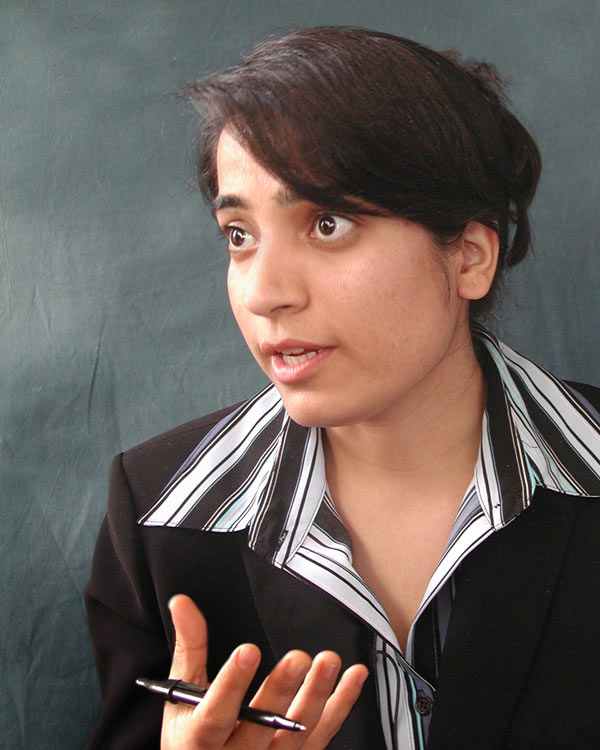 When I heard that Malalai was touring the US, I flew to Sonali Kolhatkar’s (author of Bleeding Afghanistan) California home where the young Afghan would be staying, to meet her. When Malalai walked into living room she seemed quiet and shy but once we began the interview, she became animated and energetic.
Malalai is most famous for her short speech as an elected member of the constitutional Loya Jerga (2003), when she addressed the elephant in the room that Afghans were already cognizant of and asked, how Afghanistan could become a democracy when there were warlords and criminals in the government. The audience erupted into angry chaos and her three-minute allotted speaking time was cut short after only a minute and a half. Angry lawmakers threw empty water bottles at her and shouted insults and death threats. Supporters and UN security forces gathered around to shield her. She was only 24 at the time. I met her during her first tour of the United States in 2006, after she had been elected as one of 249 Members of Parliament. Her outspokenness got her in trouble there as well and a year and two months later she was banned from that institution also.
At first, I wondered why she didn’t bite her tongue and try to work peacefully to make changes in the laws affecting women. Surely, that would be a more effective way to change women’s lives. Why stir the hornet’s nest? But then I realized that she wasn’t speaking to the other MPs, who already knew the situation, but to the international press and development leaders who were ready to pour billions in to Afghanistan’s reconstruction. They, too, were likely aware of the horrific human rights records of some of the MPs, but Malalai’s speaking out made that awareness public.
Malalai is also important because she’s a voice from a region across the country from Kabul. Most non-embedded reporters work from Kabul and investigate stories from there. Their view, the dominant one in the media, comes from that perspective and it’s very helpful to hear the voice of someone from conflict areas, especially a woman’s voice.
There is more of my interview with Malalai as well as with other Parliamentarians and women from all walks of life in my book, Gathering Strength: Conversations with Afghan Women which is available in many online bookstores as well as my publisher’s site, Pomegranate Grove Press.
****
Peggy Kelsey created the Afghan Women’s Project and in 2003 and 2010 traveled to Afghanistan to photograph and interview women. She shares her dynamic slide presentations with audiences around the world. Her book, Gathering Strength: Conversations with Afghan Women, came out in October, 2012.
Posted in Afghan Women's Project, Afghanistan, AWP 2010, Links, Other, Peggy Kelsey, Uncategorized, women | Comments Off on Meeting Malalai
Writing: Gathering Strength: Conversations with Afghan Women
September 30th, 2012
Gathering Strength, my book of conversations with Afghan women, is published! I will have books in my hands by October 8th and on Amazon sometime around early November. (email me if you want me to send you a copy before November.) The writing process has taken nearly two and a half years but really, Gathering Strength is the culmination of ten years with The Afghan Women’s Project including two trips to Afghanistan.
It’s been over a year since my last post. I couldn’t tear myself away from writing and editing to write about the book. Now it’s the end of an era of narrow focus with a workaholic intensity.
When I started working on Gathering Strength I never imagined that I was capable of creating a work this profound and this beautiful. Of course it wasn’t all, or maybe even mostly my doing. Editing, layout and cover design have shaped this book into a form worthy of the Afghan women who shared their thoughts and stories with me.
From my last day in Afghanistan in May 2012, when I realized that I needed to and could write a book, I only knew that that I’d need an editor and that I would self-publish so I could maintain control over the material and the timing of publication. As I worked, I found that this book had a life and timing of its own and all I could do was to work as hard as I could (in a way balanced for the long haul) and be open to what came my way. Realizing that probably kept me from going crazy while trying to select from the myriad publishing and other options and it helped me be patient with my unrealistic imagined timeframe.
Thankfully, during the writing and editing, when I awoke in the mornings, I was driven out of bed to begin the day’s writing, a much different experience from the resistance I’d felt during past writing efforts. By the end I couldn’t wait for the writing/editing to be completed, but I never felt it to be drudgery.
As I wrote my early drafts, I dreamed of handing over the manuscript to someone who would transform it into a finished book for me; a knight in shining armor. Oh, well, that didn’t happen. Instead, I worked closely with my editors, going back and forth over different points, sometimes changing my mind, sometimes not. It felt good to have the last word.
The transition from writing and managing my book project to putting it out into the world has been difficult. I suddenly find myself procrastinating and being distracted by the many different fronts I have to engage. Hopefully, soon, I will find my stride. Frequent posting in this blog is one of those new efforts.
I’ll end this post with a quote from the only writer in Gathering Strength, Roya. She says:
I’m going to change my life and think differently. I’m going to experience the things that are my right. I have to show my sisters, my friends, my family, and Afghan women all over the world that we can change if we have a chance.
Posted in Afghan Women's Project, AWP 2010, Other, Peggy Kelsey, Uncategorized, writing process | Comments Off on Writing: Gathering Strength: Conversations with Afghan Women
Book review: Forbidden Lessons in a Kabul Guesthouse
September 20th, 2011
Forbidden Lessons tells the story of an extraordinarily brave Afghan-American woman who began raising money and delivering aid during the Afghan Civil War and continued during the Taliban and afterwards. Her first-hand account of her struggles to deliver aid during those times is compelling and enlightening.
A few parts of this book really spoke to me. One was the story of how Suraya was accompanying a load of 10,000 blankets being hauled in three Bedford trucks to Hesar Shahee, an internally displaced persons (IDP) camp outside of Kabul during the civil war. During their trip they were shaken down by gunmen at five different roadblocks and their supply of blankets was dwindling. At the sixth, Suraya was so incensed that she challenged the armed teenaged leader, telling him that if he were a “real man” he would escort her to the camp and help give out the blankets. And he did. In the process, he was converted from a gang leader into a person who would spend the rest of his life helping others. (or so he said when they parted.)
There were other confrontations as well through the years of her bringing aid. She stood up to Taliban as well as the stoned helicopter pilot who wanted to bring extra relatives on their aid delivery trip which would have seriously overloaded the aircraft.
It was interesting that had she been a man, she would have been killed in any of these situations. And while the men she argued with grumbled and spat with anger, in the end she won their respect and often friendship.
Her description of what it was like to be in Kabul during the random bombings of the rival warlords gave me a very vivid context for the stories I’d heard during my own interviews of women going to school or just trying to survive during that time.
Her story also illustrates the error of painting the Taliban with a broad brush. Suraya talked about the shock of seeing the trees from which were hanging the severed limbs and hands of those whom the Taliban had punished. On the other hand, she was also helped by the Taliban Foreign Minister in setting up a clinic in Logar province.
After 9/11 the scope of her organization, Help the Afghan Children (HTAC) grew even more as they established more schools around the country. HTAC has also developed a peace curriculum that facilitates the development of attitudes and behaviors to help people live in harmony. The Ministry of Education is incorporating these courses into the government schools.
Sadeed, Suraya with Damien Lewis. Forbidden Lessons in a Kabul Guesthouse: The True Story of a Woman Who Risked Everything to Bring Hope to Afghanistan. NY: Hyperion Books 2011.
For an annotated bibliography of other books on Afghanistan see my website: http://www.kelseys.net/bibliography/
And my own book continues along….
Posted in Afghanistan, book review, Taliban, women | Comments Off on Book review: Forbidden Lessons in a Kabul Guesthouse
Writing
May 20th, 2011
I’ve gone way too long without posting. That’s good in some ways because I’ve been so focused on writing my book that I can’t bear to take time away for blogging. Of course that’s counter-productive. Everyone in the writing and publishing world keeps telling me to be sure to spend the necessary time to grow my platform.
My writing process has been interesting. For years, I’ve resisted the idea of writing a book but during my last days in Kabul, Elias Amidon shared his vision of the book I might write. Somehow, in that moment, the idea of writing a book finally resonated. I began the project on January 2nd, committing myself to write four hours a day, five days a week. It doesn’t seem like much except it involved fitting four hours into an already full schedule and a full life.
It was tough. I added flexibility by recommitting to 20 hours a week and ended up spending my weekends writing, never giving myself a day off. Somehow, over time, something shifted and I began getting the writing completed by Friday afternoons. Now that my presentations are all created, except for one on business women that I’ll put together over the summer, and my speaking engagements are finished for a while, 20 hours suddenly seems too easy. So, from now until the fall, I’ve ramped it up to 25 hours.
It’s interesting to watch myself. I’ve finally admitted that I’m obsessed with getting this book written, and written well. Not in terms of constantly thinking about it when I’m doing other things, but in that I compare everything else I do to writing. “Would I rather do this or write my book” becomes my guiding question. Knowing its importance, I strive to keep myself balanced so I haven’t quite become a hermit. Not quite.
Posted in Other | 2 Comments »